Outdoor Furniture for Hotels & Resorts: A Complete Buying Guide
Distinguish fully exposed poolside furniture from sheltered terrace furniture before selecting materials. The same design may need a different cushion build, drainage detail or protective treatment in each location. Buying every outdoor item to one general description can hide those differences.
Outdoor furniture is an important part of the guest experience in hotels and resorts. Pool decks, terraces, beaches, rooftop lounges, outdoor restaurants, private villas and spa areas all require furniture that supports both the design concept and the operational requirements of the property.
Unlike indoor furniture, hotel outdoor furniture is continuously exposed to environmental conditions such as sunlight, rain, humidity, heat and, in coastal locations, salt air. It is also used repeatedly by guests and frequently moved, cleaned and rearranged by hotel staff. For these reasons, outdoor furniture procurement should consider materials, construction, comfort, weather resistance, maintenance, customization, production quality and international delivery as one complete system.
For project buyers, FF&E procurement companies, developers and hotel groups, a structured buying process helps ensure that the furniture selected for each outdoor area is appropriate for its environment, function and design requirements.
Allocate Outdoor Products by Exposure and Use
Distinguish fully exposed poolside furniture from sheltered terrace furniture before selecting materials. The same design may need a different cushion build, drainage detail or protective treatment in each location. Buying every outdoor item to one general description can hide those differences.
Create a location schedule linking each furniture code to exposure, frequency of use and maintenance access. Review representative material combinations as a set, rather than approving isolated colour chips. A material substitution should be evaluated for construction and maintenance as well as appearance; visual similarity alone is not an adequate basis for approval.
1. Start with the Hotel or Resort Type
The first step is to understand the type of hospitality property being furnished.
Outdoor furniture requirements can vary significantly between:
| Urban Hotels | Beach Resorts |
| Island Resorts | Golf Resorts |
| Boutique Hotels | Luxury Resorts |
| Serviced Apartments | Resort Villas |
A beachfront resort and an urban hotel rooftop may use similar furniture categories, but their environmental and operational requirements can be very different.
2. Divide the Project into Outdoor Areas
Do not prepare one general outdoor furniture list for the entire property.
Divide the project into individual functional areas first.
Typical hotel and resort outdoor areas include:
| Pool Deck | Outdoor Restaurant |
| Beach Area | Outdoor Bar |
| Rooftop Terrace | Lounge Terrace |
| Private Villa Pool | Balcony |
| Spa Outdoor Area | Garden & Landscape Areas |
This makes it easier to select suitable furniture, materials and quantities for each environment.
3. Build the Outdoor Furniture BOQ
Once the project areas have been identified, prepare a detailed furniture BOQ.
The BOQ should record:
| Item Code | Product Description |
| Project Area | Dimensions |
| Quantity | Frame Material |
| Finish | Fabric / Upholstery |
| Tabletop Material | Drawing Reference |
This document becomes the foundation for quotation, technical development, production, quality control and packing.
4. Identify the Main Outdoor Furniture Categories
A complete hotel or resort outdoor furniture package includes several product categories.
Typical products include:
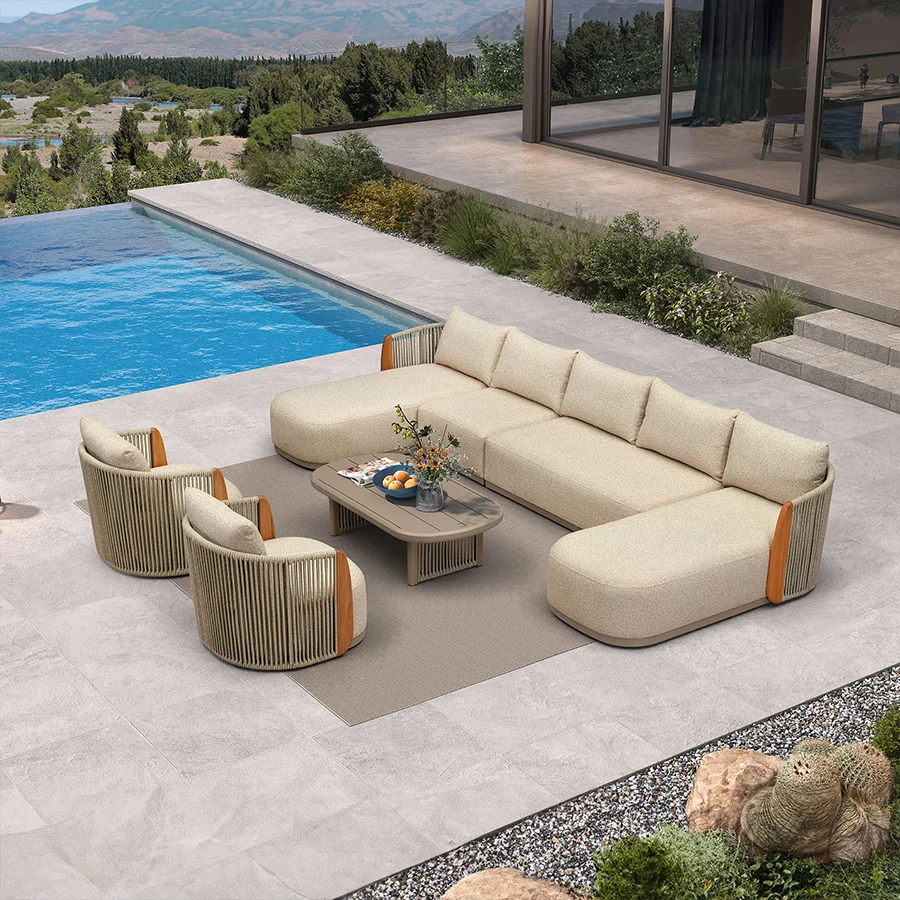
| Outdoor Sofas | Lounge Chairs |
| Sun Loungers | Daybeds |
| Dining Tables | Dining Chairs |
| Coffee Tables | Side Tables |
| Bar Stools | Parasols |
Additional products can be developed according to the individual project design.
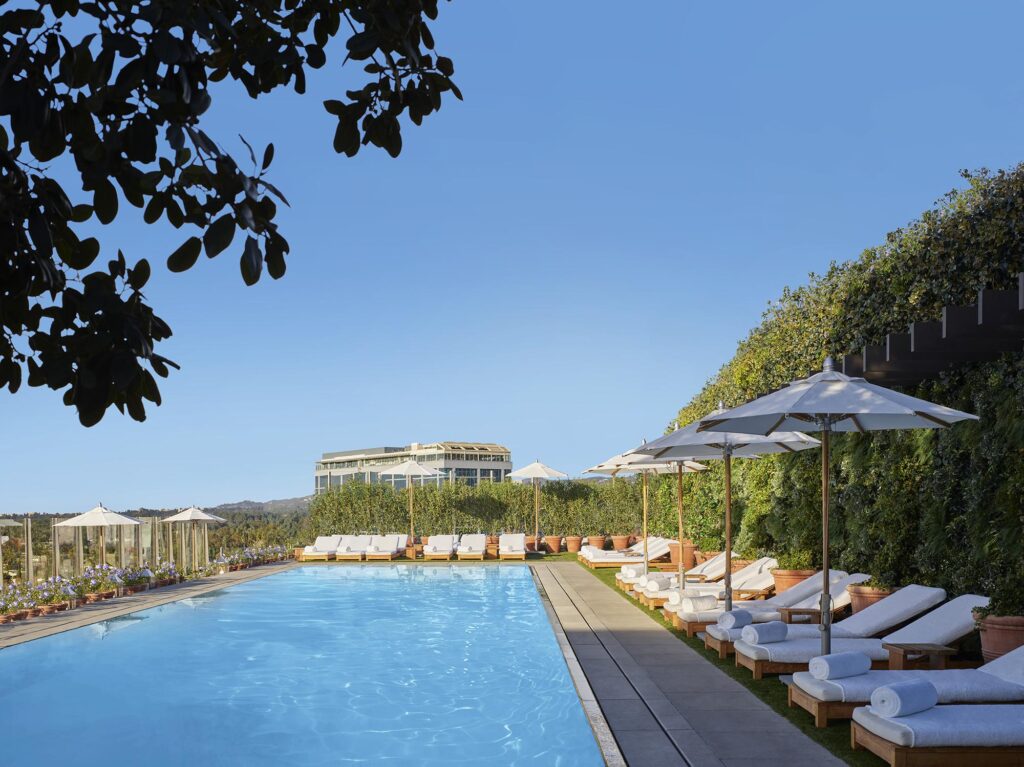
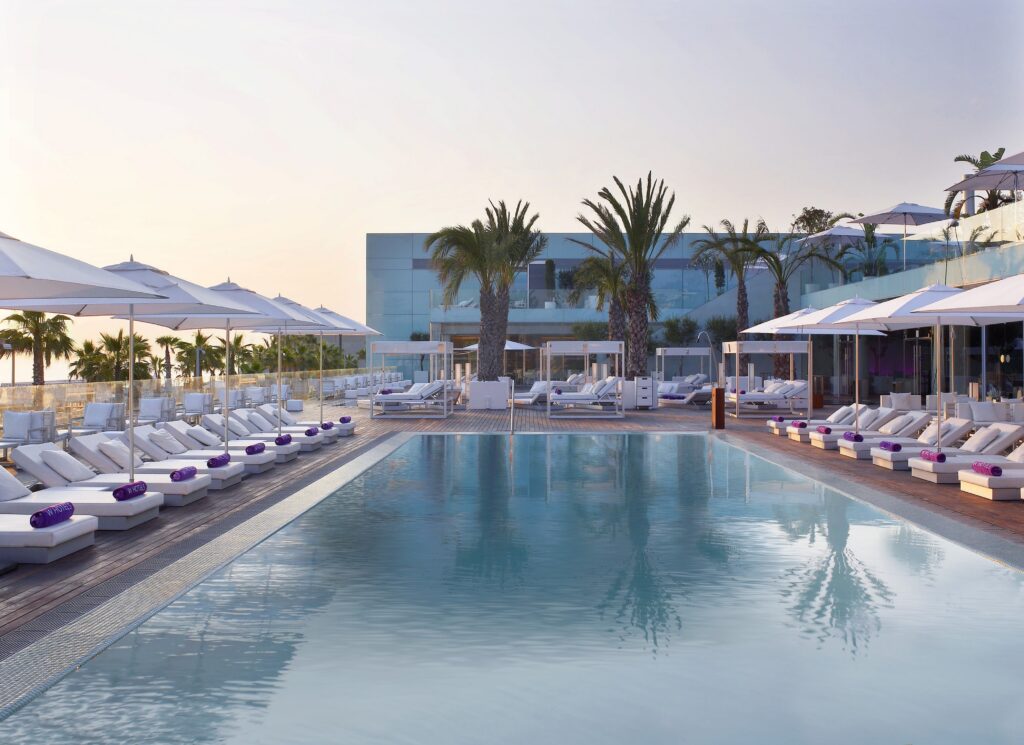
5. Plan Poolside Furniture
Pool areas usually require a combination of lounging, relaxation and occasional dining furniture.
A typical pool deck includes:
| Sun Loungers | Side Tables |
| Outdoor Sofas | Lounge Chairs |
| Daybeds | Parasols |
These products are frequently exposed to strong sunlight, moisture and wet swimwear.
Material selection and cushion construction therefore require particular attention.
6. Plan Beach Furniture
Beach resorts introduce additional environmental conditions.
Furniture can be exposed to:
| Salt Air | Strong UV |
| Humidity | Sand |
| Wind | Frequent Moisture |
For beachfront applications, the complete furniture system—including frames, hardware, coatings, upholstery and moving components—should be considered rather than evaluating only the main visible material. Salt exposure, humidity and UV should be assessed for each beachfront furniture location.
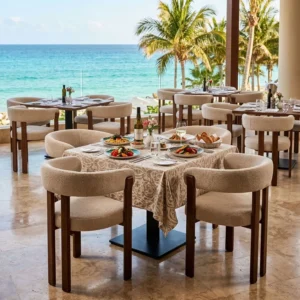
7. Plan Outdoor Restaurant Furniture
Outdoor restaurant furniture has different operational requirements from pool furniture.
Dining chairs and tables can be moved and cleaned repeatedly throughout the day.
Important considerations include:
| Table Stability | Chair Durability |
| Seat Comfort | Easy Cleaning |
| Furniture Weight | Surface Maintenance |
| Layout Flexibility | Consistent Dimensions |
Furniture should support both guest comfort and restaurant operations.
8. Plan Outdoor Bar Furniture
Outdoor bars can require dining-height, counter-height and lounge furniture within the same area.
The furniture package can include bar stools, bar tables, lounge chairs, sofas and side tables.
Seat heights and table heights should be coordinated carefully so that different products work correctly together.
9. Plan Rooftop Furniture
Rooftop terraces can have strong sun and wind exposure.
Furniture stability and weight therefore become important considerations in addition to weather resistance.
The project team should also evaluate site-specific requirements for parasols, shade structures and larger furniture elements.
Wind conditions should never be addressed solely through assumptions based on another project location.
10. Plan Private Villa Outdoor Furniture
Luxury resorts can include villas with private pools, terraces and outdoor dining areas.
These spaces can require:
| Outdoor Sofas | Lounge Chairs |
| Dining Furniture | Sun Loungers |
| Side Tables | Daybeds |
| Parasols | Accent Furniture |
Furniture dimensions and finishes can be coordinated with the individual villa type.
11. Evaluate the Project Climate
Before selecting materials, evaluate the actual environmental conditions of the property.
Important factors include:
| UV Exposure | Temperature |
| Rainfall | Humidity |
| Coastal Salt Air | Poolside Moisture |
| Wind | Covered / Uncovered Areas |
Assess each furniture location separately because exposure can vary across the same property.
12. Select the Frame Material
The frame forms the structural foundation of most outdoor furniture.
Common options include:
| Material | Typical Application |
|---|---|
| Powder-Coated Aluminum | Sofas, chairs, tables, loungers |
| Stainless Steel | Selected frames and details |
| Teak | Premium resort furniture |
| Mixed Material Construction | Customized hospitality furniture |
The appropriate material depends on the design, environment and product construction.
13. Consider Powder-Coated Aluminum
Powder-coated aluminum is widely used in commercial hospitality furniture because it combines relatively low weight with corrosion resistance and considerable design flexibility.
It can be used for sofas, dining chairs, lounge chairs, tables, loungers and daybeds.
However, buyers should still review:
| Frame Profile | Wall Thickness |
| Reinforcement | Welding |
| Surface Preparation | Powder-Coat Finish |
The term “aluminum frame” alone does not define the complete construction quality.
14. Consider Teak
Teak is widely used in premium resort environments where a warmer, natural material appearance is required.
It can be used for:
| Complete Frames | Dining Tables |
| Sun Loungers | Chair Components |
| Arm Details | Tabletops |
Buyers should also understand that natural timber changes in appearance during exterior exposure and requires an appropriate maintenance strategy.
15. Consider Outdoor Rope and Woven Materials
Outdoor rope and synthetic woven materials can create a lighter, more relaxed resort appearance.
They are commonly applied to sofas, lounge chairs, dining chairs, bar stools and daybeds.
Important considerations include:
| UV Suitability | Color Stability |
| Weaving Quality | Tension |
| Edge Finishing | Cleaning |
The frame underneath the weaving remains an equally important structural component.
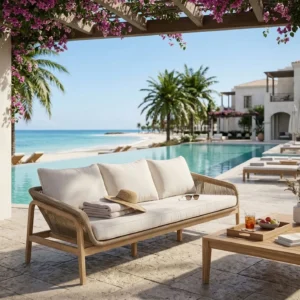
16. Select Outdoor Fabrics
Outdoor fabrics should be selected according to the intended environment and usage.
Important considerations include:
| UV Exposure | Color Stability |
| Moisture | Cleaning |
| Abrasion | Texture |
| Appearance | Maintenance |
For commercial projects, fabric selection should be coordinated with the cushion system rather than treated as an independent decorative choice. Review fade resistance, moisture management and cleanability against the selected upholstery specification.
17. Select the Cushion System
Poolside sofas, loungers and daybeds can be exposed to rain and wet swimwear.
Appropriate outdoor cushion construction can include:
| Outdoor Foam | Quick-Dry Foam |
| Drainage Construction | Removable Covers |
| Outdoor Fabric | Appropriate Cushion Thickness |
Moisture should be able to move through or away from the cushion rather than remain trapped inside.
18. Select Outdoor Tabletop Materials
Hotel outdoor tables can use several surface materials depending on the project specification.
Options include:
| Teak | Stone |
| Sintered Surfaces | Exterior-Suitable HPL |
| Glass | Ceramic / Porcelain Surfaces |
Tabletop weight, edge details, support construction and maintenance should be evaluated together.
19. Check Hardware and Fasteners
Small components can have a significant effect on long-term furniture performance.
Review:
| Screws | Bolts |
| Connectors | Hinges |
| Brackets | Glides |
| Reclining Mechanisms | Other Moving Components |
These components should be appropriate for the intended outdoor environment.
20. Consider UV Resistance
Sunlight can affect fabrics, coatings, woven materials, plastics and timber finishes.
Projects with strong sun exposure require closer attention to UV performance.
This is particularly relevant for tropical resorts, Middle Eastern hotels, rooftop terraces and exposed pool areas.
21. Consider Moisture and Drainage
Outdoor furniture should avoid unnecessary water retention.
Depending on the furniture type, moisture management can involve:
| Frame Drainage | Cushion Drainage |
| Ventilation | Suitable Upholstery |
| Open Construction | Appropriate Surface Materials |
These details should be considered during technical development rather than after the furniture has been manufactured.
22. Consider Corrosion Resistance
For coastal and poolside projects, corrosion resistance should be evaluated across the complete product.
Do not review only the main frame.
Hardware, fasteners, connectors and other exposed metal components should also correspond with the intended environment.
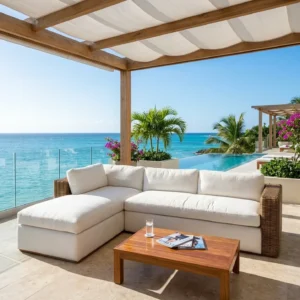
23. Evaluate Commercial Furniture Construction
Hotel outdoor furniture is used differently from furniture in a private residence.
Guests use it repeatedly, while hotel teams move, clean and rearrange it as part of daily operations.
Structural construction should therefore be evaluated according to the furniture type and expected use.
Important points include:
| Frame Strength | Joint Construction |
| Welding | Reinforcement |
| Stability | Hardware |
| Upholstery Construction | Functional Components |
24. Evaluate Comfort
Outdoor furniture still needs to provide the level of comfort expected in a hospitality environment.
Important dimensions include seat height, seat depth, back angle, arm height and cushion thickness.
Different products require different comfort characteristics.
A restaurant dining chair should not be evaluated in the same way as a poolside daybed or deep lounge sofa.
25. Consider Furniture Weight
Furniture weight affects both guest use and hotel operations.
Very heavy furniture can be difficult for staff to move, while furniture that is too light may be unsuitable for exposed locations.
The appropriate balance depends on the furniture category and project environment.
26. Consider Stackability
For restaurants, event terraces and flexible hospitality spaces, stackable furniture can simplify storage and operational changes.
If stackability is required, it should be established during product selection or technical development.
It should not be assumed that visually similar chairs will stack correctly.
27. Coordinate Parasols with the Furniture Package
Parasols are often an important part of hotel outdoor spaces.
They should be coordinated with:
| Furniture Layout | Table Locations |
| Sun Loungers | Daybeds |
| Canopy Color | Frame Finish |
| Base Requirements | Project Environment |
Site-specific wind conditions and local requirements should also be reviewed by the relevant project team.
28. Decide What Should Be Customized
Hospitality projects often require customization to achieve the required dimensions, design or finish.
Customization can include:
| Furniture Dimensions | Frame Details |
| Powder-Coat Colors | Rope Colors |
| Outdoor Fabrics | Cushion Dimensions |
| Tabletops | Teak Details |
Not every item needs to be completely redesigned.
A practical project strategy can standardize where possible and customize where it provides clear design or functional value.
29. Prepare Technical Drawings
For customized products, technical drawings establish the manufacturing information.
They can define:
| Overall Dimensions | Frame Construction |
| Material References | Cushion Thickness |
| Finish Codes | Hardware |
| Tabletops | Functional Details |
Approved drawings help reduce differences between the design requirement and the manufactured product.
30. Approve Materials and Finishes
Before production, establish approved material references.
These can include:
| Powder-Coat Sample | Teak Finish |
| Rope Sample | Woven Material |
| Outdoor Fabric | Tabletop Sample |
| Cushion Construction | Hardware |
The approved references should remain available for comparison during production and final inspection.
31. Review Prototypes for Key Products
For large hotel and resort projects, reviewing a prototype or initial production item can be useful for important repeated products.
Typical items include:
| Lounge Chairs | Dining Chairs |
| Outdoor Sofas | Sun Loungers |
| Daybeds | Custom Tables |
The review can confirm dimensions, comfort, construction, materials and finishes before the remaining production quantity proceeds.
32. Confirm Quantities Before Production
Hospitality projects can contain similar products distributed across multiple outdoor areas.
Before production, quantities should be cross-checked against:
| BOQ | Furniture Layout |
| Area Schedule | Villa Types |
| Restaurant Layout | Pool Layout |
Late quantity changes can affect material purchasing, production scheduling and shipment planning.
33. Control Production Consistency
A resort project may contain hundreds of furniture pieces using the same finishes and fabrics.
Production therefore requires consistency across different batches.
Control should cover:
| Frame Dimensions | Powder-Coat Color |
| Teak Finish | Rope |
| Fabric | Cushion Construction |
| Tabletop Appearance | Workmanship |
Approved references provide the benchmark.
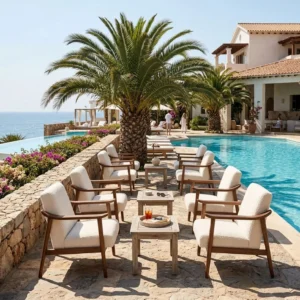
34. Inspect Furniture Before Packing
Quality control should take place throughout production, followed by final inspection before packing.
Final checks can include:
| Dimensions | Stability |
| Welding | Finish |
| Weaving | Fabric |
| Cushion Fit | Hardware |
| Function | Item Code |
Any required corrections should be completed before products are released for shipment.
35. Plan Project-Based Packing
Outdoor furniture can contain metal finishes, timber, fabrics, glass, stone and other surfaces requiring different protection.
Packing should therefore correspond with the individual product.
For hotel projects, products should also be organized according to the project structure.
For example:
Hotel → Outdoor Area → Item Code → Package Number
36. Use Clear Package Labels
Package labels should connect physical products with the BOQ and packing list.
A useful label can identify:
| Project Name | Project Area |
| Item Code | Product |
| Quantity | Package Number |
This becomes particularly important for resorts with separate villas, restaurants, pools and beach areas.
37. Plan Container Loading
Outdoor furniture varies considerably in size.
A shipment can contain dining chairs, sofas, large daybeds, stone tables and parasols within the same project.
Container planning should therefore consider:
| Package Dimensions | Product Weight |
| Surface Protection | Loading Sequence |
| Space Utilization | Unloading Requirements |
Logistics should be considered before production is complete rather than only when the furniture is ready to ship.
38. Define the Manufacturer’s Supply Scope
The responsibilities of the manufacturer should be clear before the project is confirmed.
For Craftell Home, the outdoor furniture project workflow focuses on:
Project Brief → Furniture Scope & BOQ → Technical Development → Material & Finish Approval → Manufacturing → Quality Control → Project-Based Packing → Export Delivery
On-site installation is not included in Craftell Home’s scope of supply and is handled by the client or local contractor.
39. Compare Quotations Correctly
Do not compare quotations only by total price.
Confirm whether each supplier is pricing the same:
| Frame Construction | Materials |
| Outdoor Fabric | Cushion System |
| Finish Standard | Tabletop |
| Hardware | Quantities |
| Packing | Specifications |
Two products can look almost identical in photographs while using significantly different materials and construction.
40. Evaluate the Manufacturer, Not Only the Product
For project procurement, the supplier needs to support more than individual furniture production.
Evaluate:
| Outdoor Furniture Experience | Custom Manufacturing |
| Material Knowledge | Technical Development |
| Production Capacity | Finish Control |
| Quality Control | Project Packing |
| Export Experience | Project Coordination |
This is especially important for hotels and resorts purchasing several outdoor furniture categories within one project.
41. Build a Complete Procurement Checklist
Before placing the order, confirm that the major project information is complete.
Project Information
| Project Areas | Furniture BOQ |
| Quantities | Dimensions |
| Drawings | Delivery Destination |
Product Information
| Frame Material | Finish |
| Outdoor Fabric | Cushion Construction |
| Tabletop | Hardware |
Production & Delivery
| Approved References | Production Schedule |
| Quality Control | Packing Requirements |
| Package Labels | Export Delivery |
A structured checklist reduces the risk of important decisions remaining unresolved when production begins.
42. Think Beyond the Initial Purchase Price
The lowest-priced outdoor furniture is not automatically the lowest-cost solution for a hotel or resort.
Procurement decisions should also consider:
Material Suitability → Construction → Maintenance → Operational Use → Replacement Requirements
Premature fading, corrosion, water retention or structural failure can create replacement costs after the property has opened, so maintenance and replacement requirements should be considered during procurement.
The purchasing decision should therefore consider how the furniture will actually perform in the property rather than focusing only on the initial quotation.
Conclusion
Buying outdoor furniture for a hotel or resort requires coordination between design, environmental conditions, commercial operation, manufacturing and international delivery.
The process should begin by dividing the property into individual outdoor areas and defining the furniture BOQ. Materials and construction can then be selected according to the actual environment, whether the furniture will be used beside a pool, on a beach, in an outdoor restaurant, on a rooftop terrace or around a private villa.
For larger hospitality projects, the complete procurement process can follow:
Outdoor Areas → Furniture Scope & BOQ → Material Selection → Technical Development → Material & Finish Approval → Production → Quality Control → Project-Based Packing → Export Delivery
This approach gives project buyers clearer control over furniture categories, specifications, quantities and finishes while maintaining consistency across the hotel or resort.
Outdoor Furniture Procurement & Production Questions
What outdoor furniture does a hotel or resort typically need?
The package can include outdoor sofas, lounge chairs, dining tables, dining chairs, sun loungers, daybeds, coffee tables, side tables, bar furniture and parasols, depending on the property’s outdoor areas.
What is the most common frame material for hotel outdoor furniture?
Powder-coated aluminum is widely used because it combines relatively low weight, corrosion resistance and design flexibility. Teak, stainless steel and mixed-material construction are also used depending on the project.
What should be considered for a beachfront resort?
Salt air, humidity, UV exposure, sand, moisture and maintenance should be considered when specifying frames, hardware, coatings, fabrics, cushions and moving components.
What furniture is required around a hotel swimming pool?
Typical products include sun loungers, side tables, parasols, outdoor sofas, lounge chairs and daybeds. The exact package depends on the pool layout and operating concept.
Should hotel outdoor furniture use quick-dry foam?
Quick-dry or other suitable outdoor cushion systems are commonly specified for exposed seating where moisture management is important, particularly around pools and other uncovered areas.
Can hotel outdoor furniture be customized?
Yes. Dimensions, materials, frame details, finishes, fabrics, rope colors, cushions and tabletops can be customized according to the approved project requirements.
How should a resort outdoor furniture BOQ be organized?
The BOQ should identify item codes, furniture descriptions, project areas, quantities, dimensions, materials, finishes and drawing references so the same information can be followed through quotation, production and packing.
How should hotel outdoor furniture be packed for export?
Products should be protected according to their materials and finishes and labeled by project area, item code and package number. Packing documentation should correspond with the BOQ and physical package labels.
Does Craftell Home provide on-site installation?
On-site installation is not included in Craftell Home’s scope of supply. Craftell Home focuses on technical development, outdoor furniture manufacturing, material coordination, quality control, project-based packing and export delivery. Local site work is handled by the client or local contractor.
Published by Craftell Home · Custom Furniture Manufacturer & FF&E Project Supplier
Related outdoor furniture project
Our published Four Seasons Resort Bali at Sayan project describes the supply of outdoor furniture for private pool villas, pool decks, dining areas and lounge spaces. Review the stated supply scope when assessing its relevance to your own project.
This article provides manufacturing and procurement guidance. The final product configuration, acceptance criteria and delivery scope are defined by the approved drawings, specifications, samples and order documents for each project.
Explore Outdoor Furniture Project Resources
Continue with our outdoor furniture solutions and selected projects.