How to Choose an Outdoor Furniture Manufacturer for Hospitality Projects
A supplier review should connect the physical sample with the frame drawing, finish reference, weaving pattern and cushion construction. Ask which operations are controlled in-house and who checks outsourced components before the final product is packed.
Outdoor furniture for hospitality projects must perform very differently from furniture used indoors. Hotel pool decks, resort terraces, beach clubs, rooftop lounges, outdoor restaurants and private villa areas are exposed to sunlight, heat, rain, humidity, salt air and frequent guest use.
Choosing an outdoor furniture manufacturer therefore requires more than comparing product appearance and price. Project buyers should evaluate the manufacturer’s ability to manage outdoor materials, structural construction, weather-resistant finishes, custom dimensions, upholstery, production consistency, quality control, project-based packing and international delivery.
A capable manufacturer should be able to translate the project’s design requirements into outdoor furniture that is suitable for the intended environment while maintaining consistent appearance and quality across the complete furniture package.
Check How the Outdoor Sample Will Be Reproduced
A supplier review should connect the physical sample with the frame drawing, finish reference, weaving pattern and cushion construction. Ask which operations are controlled in-house and who checks outsourced components before the final product is packed.
Review a proposed inspection record for the same item, including how changes to rope, coating or fabric are approved. The important question is whether the supplier can maintain the accepted construction and appearance across the order, rather than whether one showroom chair looks suitable. Record any performance claims that still need product-specific evidence.
1. Start with the Hospitality Project Type
The first step is to understand where and how the outdoor furniture will be used.
Hospitality outdoor furniture can be required for:
| Hotels & Resorts | Beach Clubs |
| Restaurants & Bars | Rooftop Terraces |
| Pool Decks | Private Villas |
| Outdoor Lounges | Spa & Wellness Areas |
Each environment creates different requirements for materials, construction, comfort and weather resistance.
A beachfront resort, for example, can require stronger consideration of salt-air corrosion than a covered restaurant terrace.
2. Define the Outdoor Furniture Scope
Before comparing manufacturers, establish the complete furniture scope.
A hospitality outdoor furniture package can include:
| Outdoor Sofas | Lounge Chairs |
| Sun Loungers | Daybeds |
| Dining Tables | Dining Chairs |
| Coffee & Side Tables | Bar Stools |
| Outdoor Bar Furniture | Parasols |
The scope should also identify quantities, dimensions, project areas and material requirements.
A clear scope allows manufacturers to prepare more accurate technical proposals and quotations.
3. Organize Furniture by Project Area
Outdoor furniture should not be treated as one general product category.
Separate the project into functional areas such as:
| Pool Deck | Outdoor Dining |
| Beach Area | Rooftop Terrace |
| Outdoor Lounge | Bar Area |
| Private Villa Terrace | Garden & Landscape Areas |
This helps determine which furniture types and performance requirements apply to each location.
It also improves BOQ management, production tracking, packing and final project distribution.
4. Check the Manufacturer’s Hospitality Project Experience
Hospitality projects involve requirements that differ from ordinary residential furniture orders.
The manufacturer should understand:
| Project BOQs | Furniture Layouts |
| Custom Dimensions | Material Specifications |
| Finish References | Technical Drawings |
| Production Schedules | Project-Based Packing |
Experience with hotels, resorts and commercial outdoor spaces is particularly useful when a project contains many furniture types across several operating areas.
5. Evaluate Outdoor Material Knowledge
Material selection is one of the most important factors when choosing an outdoor furniture manufacturer.
The manufacturer should understand how different materials perform under exterior conditions.
Typical materials can include:
| Powder-Coated Aluminum | Stainless Steel |
| Outdoor Timber | Synthetic Woven Materials |
| Outdoor Fabrics | Quick-Dry Foam |
| Stone & Sintered Surfaces | Exterior-Suitable HPL |
The correct combination depends on the design, location, exposure and expected use of the furniture.
6. Consider the Actual Project Climate
There is no single outdoor material specification suitable for every hospitality project.
The manufacturer should consider environmental conditions including:
| Strong UV Exposure | High Temperatures |
| Rain & Humidity | Coastal Salt Air |
| Poolside Moisture | Seasonal Temperature Changes |
For coastal hotels and beach resorts, corrosion resistance becomes particularly important.
For projects in regions with intense sunlight, UV resistance and finish stability require greater attention.
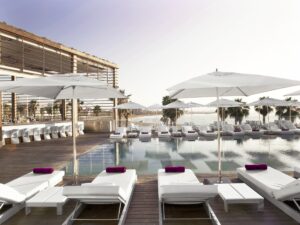
7. Check Aluminum Frame Specifications
Aluminum is widely used for hospitality outdoor furniture because of its relatively low weight and resistance to corrosion.
However, simply specifying “aluminum” is not enough.
The manufacturer should control:
| Tube Dimensions | Wall Thickness |
| Structural Reinforcement | Welding Quality |
| Surface Preparation | Powder-Coated Finish |
The frame construction should correspond with the furniture dimensions and intended commercial use.
8. Review Welding and Structural Construction
Outdoor furniture used in hospitality environments can experience frequent movement and repeated daily use.
Frame construction therefore needs careful control.
When evaluating a manufacturer, review how the factory manages welding, joints, reinforcement and structural stability.
Large sofas, daybeds, sun loungers and commercial dining furniture can require different reinforcement strategies.
9. Evaluate Powder-Coating Quality
Powder coating affects both appearance and protection of metal outdoor furniture.
Important factors include:
| Color Consistency | Surface Preparation |
| Texture | Gloss Level |
| Coating Coverage | Finish Quality |
The approved finish reference should remain consistent across different furniture types manufactured for the same project.
10. Check Corrosion-Resistance Details
Corrosion resistance is especially important for coastal resorts, beach clubs and poolside environments.
It is not only the main furniture frame that matters.
The manufacturer should also consider exposed hardware, fasteners, connectors and other metal components.
Using an appropriate main frame while ignoring smaller metal components can create long-term maintenance problems.
11. Review Outdoor Timber Selection
Outdoor timber furniture requires careful material and finish selection.
The manufacturer should understand how the specified timber responds to moisture, sunlight and exterior exposure.
Important considerations include timber selection, moisture control, construction details, surface preparation and exterior finishing.
The expected maintenance requirements should also be understood at the project stage.
12. Check Synthetic Woven Materials
Synthetic woven materials are frequently used for resort sofas, lounge chairs and daybeds.
When specified, evaluate:
| Material Quality | UV Resistance |
| Color Consistency | Weaving Quality |
| Tension | Edge Finishing |
The woven surface should also integrate cleanly with the furniture frame and cushion system.
13. Evaluate Outdoor Fabric Knowledge
Outdoor upholstery requires fabrics designed for exterior conditions.
The manufacturer should work according to the approved fabric specification and understand requirements relating to:
| UV Exposure | Moisture |
| Color Stability | Cleaning |
| Abrasion | Hospitality Use |
For large projects, fabric codes and colors should be clearly controlled throughout production.
14. Check Quick-Dry Cushion Construction
Poolside and exposed lounge furniture requires particular attention to cushion construction.
Quick-dry foam or other specified outdoor cushion systems can help moisture move through the cushion rather than remain trapped inside.
The complete cushion construction should consider:
| Foam Type | Cushion Thickness |
| Internal Drainage | Fabric Construction |
| Zippers | Removable Covers |
This is especially important for sun loungers, outdoor sofas and daybeds.
15. Review Tabletop Material Options
Outdoor tables can use several different surface materials depending on design and environmental requirements.
These can include stone, sintered surfaces, exterior-grade laminates, glass and other suitable materials.
The manufacturer should consider appearance together with:
| Weather Exposure | Weight |
| Edge Construction | Structural Support |
| Cleaning | Maintenance |
Large stone tabletops can also affect frame construction and packing requirements.
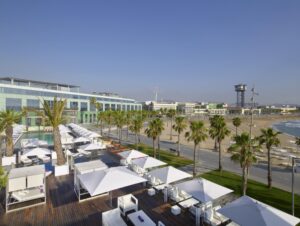
16. Check UV Resistance
Strong sunlight can affect fabrics, coatings, synthetic materials and timber finishes.
For projects with high UV exposure, the manufacturer should coordinate suitable materials and approved finish systems according to the project specification.
This is particularly important for Middle Eastern resorts, tropical destinations, rooftop spaces and exposed pool decks.
17. Check Moisture Management
Outdoor furniture should be designed so that water does not remain unnecessarily trapped within cushions, frames or enclosed components.
Depending on the product, moisture management can involve drainage openings, breathable construction and suitable cushion systems.
These details should be considered during product development rather than after production.
18. Evaluate Custom Manufacturing Capability
Hospitality projects often require furniture to be manufactured specifically for the project.
Customization can involve:
| Dimensions | Frame Construction |
| Materials | Fabric |
| Finish Colors | Cushion Details |
| Tabletops | Decorative Elements |
A manufacturer should therefore be able to develop furniture from project drawings, specifications, reference images and approved material information rather than relying only on standard catalog products.
19. Review Technical Drawing Capability
Technical drawings help convert design requirements into manufacturing information.
For custom outdoor furniture, drawings can define:
| Overall Dimensions | Frame Dimensions |
| Construction Details | Cushion Thickness |
| Material References | Finish Codes |
| Hardware | Functional Details |
These drawings create a technical reference between the project team and the factory.
20. Check Material and Finish Approval Procedures
A manufacturer should have a clear approval process before mass production.
Depending on the project, approvals can include:
| Frame Material | Powder-Coat Finish |
| Timber Finish | Outdoor Fabric |
| Woven Material | Cushion Construction |
| Tabletop Material | Hardware |
Approved references should then be controlled throughout production.
21. Evaluate Prototype and Sample Development
For large hospitality projects, reviewing a prototype or first production item can help confirm important details before the remaining quantity proceeds.
The review can cover dimensions, comfort, materials, construction, finish, upholstery and functional details.
This is particularly useful for custom sofas, lounge chairs, sun loungers and daybeds that will be repeated in significant quantities.
22. Check Production Capacity
A manufacturer should have sufficient production capacity for the project quantity and schedule.
This does not simply mean having a large factory.
The more important question is whether the manufacturer can coordinate different production processes while maintaining consistency across the complete project.
A resort package, for example, can contain metal furniture, upholstered furniture, timber components, stone tabletops and parasols within one procurement scope.
23. Review Production Management
Once production begins, the manufacturer should control approved information carefully.
Production records should correspond with:
| Item Codes | Quantities |
| Drawings | Materials |
| Finish References | Fabric Codes |
| Project Areas | Production Status |
This becomes increasingly important when many similar products use different dimensions, colors or fabrics.
24. Evaluate Quality Control During Production
Quality control should take place throughout manufacturing rather than only after products are completed.
Checks can be carried out during frame fabrication, welding, surface finishing, upholstery, assembly and final production.
Early inspection helps prevent the same issue from being repeated across a large production quantity.
25. Check Final Inspection Standards
Before packing, completed outdoor furniture should be inspected against approved project information.
Final inspection can include:
| Dimensions | Structural Stability |
| Welding | Finish Quality |
| Fabric & Stitching | Cushion Fit |
| Hardware | Function |
Item codes and quantities should also be verified before products are released for packing.
26. Check Finish Consistency Across the Project
A hospitality project may use the same finish across several furniture categories.
For example, outdoor sofas, lounge chairs, dining chairs, tables and sun loungers can share the same powder-coated frame color.
The manufacturer should maintain approved finish references throughout production so that furniture supplied to the same space appears coordinated.
27. Evaluate Product Comfort
Durability alone is not sufficient for hospitality furniture.
Outdoor sofas, lounge chairs, dining chairs, sun loungers and daybeds should also support the intended guest experience.
Comfort depends on several factors, including seat height, seat depth, back angle, cushion density and furniture proportions.
For custom projects, these details should be reviewed during product development.
28. Check Furniture Stability and Functional Details
Different outdoor furniture categories require different functional checks.
Sun loungers may have adjustable backrests. Dining tables require stable bases. Daybeds can contain multiple structural components. Parasols require suitable base and frame coordination.
The manufacturer should inspect these functions before packing.
29. Review Project-Based Packing
Outdoor furniture can contain painted frames, upholstery, stone, glass and other surfaces that require protection during international transportation.
Packing should therefore be designed according to each furniture type.
The manufacturer should protect:
| Frame Surfaces | Corners & Edges |
| Upholstery | Tabletops |
| Glass | Stone |
| Hardware | Decorative Components |
Products should not simply be packed according to whichever method is fastest at the factory.
30. Check the Package Labeling System
For hotel and resort projects, package identification is important because products can be distributed across multiple areas.
A useful labeling structure can follow:
Project → Area → Item Code → Quantity → Package Number
For example:
Resort → Pool Deck → OD-SL-01 → 2 PCS → Package 18
This allows the receiving team to identify products without opening every package.
31. Evaluate Export Experience
International hospitality projects require manufacturers to understand export packing, container loading and shipping documentation.
The manufacturer should be able to coordinate project quantities with container planning while maintaining clear packing records.
Export experience becomes especially important when furniture includes large daybeds, sofas, parasols or stone components that require different packing and loading methods.
32. Understand the Manufacturer’s Delivery Scope
The manufacturer’s responsibilities should be clearly defined before the order is confirmed.
For Craftell Home, the project workflow focuses on:
Technical Development → Material Coordination → Manufacturing → Quality Control → Project-Based Packing → Export Delivery
On-site installation is not included in Craftell Home’s scope of supply and is handled by the client or local contractor.
For outdoor loose furniture, most products are delivered as finished or appropriately packed furniture according to the agreed export scope.
33. Compare Manufacturers Beyond Unit Price
A low unit price does not necessarily represent a lower total project cost.
When comparing quotations, consider whether each manufacturer is pricing the same:
| Materials | Frame Construction |
| Fabric | Cushion System |
| Finish Standard | Hardware |
| Packing | Product Specifications |
A quotation based on weaker materials or simplified construction should not be treated as directly equivalent to one based on the approved project specification.
34. Ask for a Clear Quotation Structure
A project quotation should allow buyers to understand what is being priced.
Useful information includes:
| Item Code | Product Description |
| Dimensions | Quantity |
| Unit Price | Material |
| Finish | Upholstery |
Where appropriate, the quotation can also identify relevant packing or commercial conditions.
This makes later revisions easier to manage.
35. Review Communication and Project Coordination
Hospitality furniture projects usually involve several rounds of technical and commercial communication.
The manufacturer should be able to coordinate questions relating to drawings, dimensions, materials, finishes, quantities and production status.
Clear communication becomes particularly important when the buyer, designer, procurement company and manufacturer are located in different countries.
36. Use a Manufacturer Evaluation Checklist
Before selecting an outdoor furniture manufacturer, review the complete capability rather than one individual product.
A practical evaluation should cover:
| Hospitality Project Experience | Outdoor Material Knowledge |
| Custom Manufacturing | Technical Drawings |
| Material & Finish Control | Production Capacity |
| Quality Control | Project-Based Packing |
| Export Experience | Project Coordination |
The strongest supplier relationship is created when the manufacturer can support the project consistently from the initial furniture schedule through production and international delivery.
Conclusion
Choosing an outdoor furniture manufacturer for a hospitality project requires a balance of design execution, material knowledge, manufacturing capability and project control.
The manufacturer should understand how UV exposure, moisture, heat, salt air and intensive hospitality use affect furniture materials and construction. At the same time, it should be able to manage custom dimensions, technical drawings, approved finishes, upholstery, production consistency, quality inspection and project-based packing.
For hotels and resorts purchasing multiple outdoor furniture categories, evaluating the complete manufacturing and delivery process is more useful than comparing individual products only.
A structured procurement process helps move the project from Furniture Scope & BOQ → Technical Development → Material & Finish Approval → Manufacturing → Quality Control → Project-Based Packing → Export Delivery with clearer control at every stage.
Outdoor Furniture Procurement & Production Questions
What should I look for in an outdoor furniture manufacturer for a hotel project?
Review hospitality project experience, outdoor material knowledge, custom manufacturing capability, technical development, finish control, quality inspection, packing and international delivery experience.
What materials are commonly used for hospitality outdoor furniture?
Common materials include powder-coated aluminum, stainless steel, outdoor timber, synthetic woven materials, outdoor fabrics, quick-dry foam, stone, sintered surfaces and other exterior-suitable materials selected according to the project environment.
Is aluminum suitable for hotel outdoor furniture?
Aluminum is widely used for outdoor hospitality furniture, but frame dimensions, wall thickness, welding, reinforcement, surface preparation and finish quality still need to be evaluated.
Why is quick-dry foam used in outdoor furniture?
Quick-dry cushion systems help manage moisture in exposed seating and are particularly useful for poolside sofas, lounge chairs, sun loungers and daybeds.
What should be considered for coastal resort furniture?
Coastal projects require particular attention to salt-air exposure, corrosion resistance, hardware, coatings, outdoor fabrics and other materials exposed to the environment.
Can outdoor furniture be customized for a hospitality project?
Yes. Project furniture can be manufactured according to required dimensions, materials, fabrics, colors, construction details, tabletops and other approved specifications.
How should outdoor furniture be packed for hotel projects?
Furniture should be protected according to its materials and finishes and clearly labeled by project, area, item code and package number to support receiving and distribution.
Does Craftell Home provide on-site installation?
On-site installation is not included in Craftell Home’s scope of supply. Craftell Home focuses on custom manufacturing, quality control, project-based packing and export delivery, while local site work is handled by the client or local contractor.
Published by Craftell Home · Custom Furniture Manufacturer & FF&E Project Supplier
Related outdoor furniture project
Our published Four Seasons Resort Bali at Sayan project describes the supply of outdoor furniture for private pool villas, pool decks, dining areas and lounge spaces. Review the stated supply scope when assessing its relevance to your own project.
This article provides manufacturing and procurement guidance. The final product configuration, acceptance criteria and delivery scope are defined by the approved drawings, specifications, samples and order documents for each project.
Explore Outdoor Furniture Project Resources
Continue with our outdoor furniture solutions and selected projects.