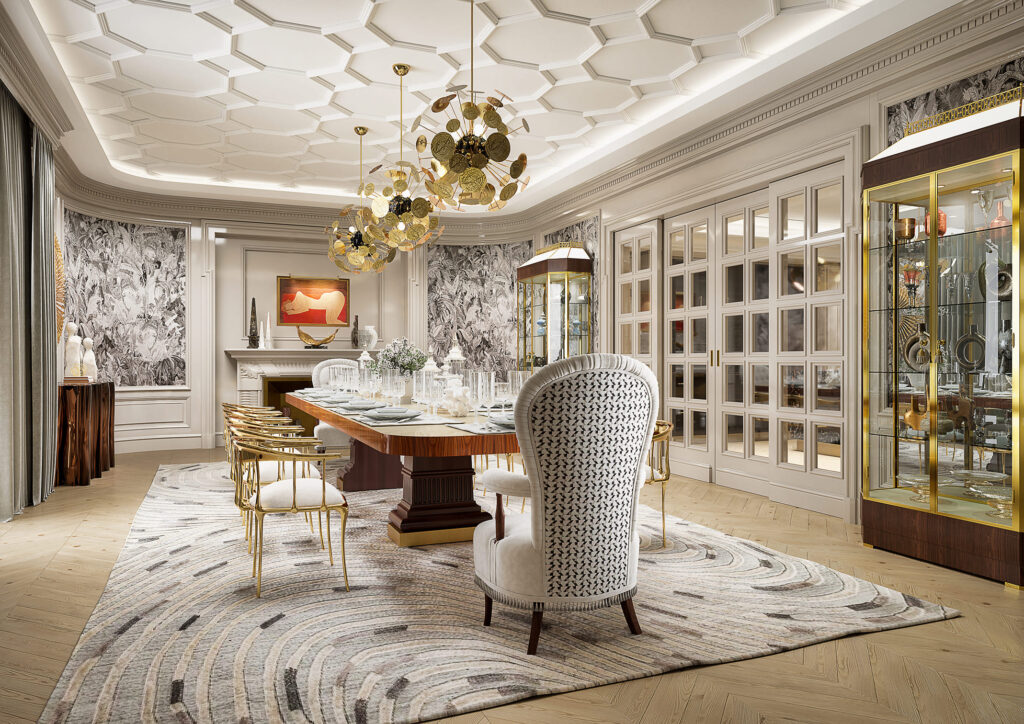
Luxury Residential Furniture Procurement Timeline: From Design Approval to Delivery
Record which drawings, materials and samples are approved and which remain open. A production duration becomes useful only when its start conditions are clear; changes to shared finishes can affect several furniture items together.
Luxury residential furniture procurement involves much more than placing an order and waiting for production. A private villa, penthouse, luxury apartment or high-end residence may contain dozens or hundreds of customized items across living rooms, dining areas, bedrooms, studies, entertainment spaces and outdoor areas.
The procurement package may include loose furniture, fixed interiors, mattresses, custom rugs, decorative lighting, artwork, interior decorative accessories and outdoor furniture. Each category can have different drawing, material, sampling, production and delivery requirements.
For project teams, one of the most important questions is therefore:
How long does a custom luxury residential furniture project take from design approval to final delivery?
There is no single timeline that applies to every project. The schedule depends on the number of customized items, drawing status, material availability, sample requirements, production complexity, quantity, destination and installation scope.
This guide explains the main procurement stages, what happens during each stage and which decisions can affect the overall project schedule.

Track Approval Time Separately from Production
Record which drawings, materials and samples are approved and which remain open. A production duration becomes useful only when its start conditions are clear; changes to shared finishes can affect several furniture items together.
At Craftell Home, custom development, paint finishing and final dispatch connect through the project factory. The schedule should allow for the approved sample to become the reference for manufacturing and final inspection.
1. Understand the Complete Procurement Timeline
A typical luxury residential furniture project can be divided into the following stages:
Design Approval → Scope & BOQ → Technical Review → Shop Drawings → Materials & Finishes → Samples → Prototype Approval → Material Procurement → Mass Production → Quality Control → Packing → Export → Delivery → Local Installation
These stages are connected.
For example, production cannot be released if critical drawings remain unapproved. Upholstery cannot begin if the selected fabric has not arrived. Fixed interiors may require verified site dimensions before manufacturing can be finalized.
The schedule should therefore be managed as a sequence of approvals and production milestones rather than one single manufacturing lead time.
2. Stage 1: Confirm the Furniture Design
The procurement process should begin after the furniture design has reached a sufficiently developed stage.
The project team should ideally have:
| ✓ Furniture plans | ✓ Furniture schedules |
| ✓ Product references | ✓ Dimensions |
| ✓ Material direction | ✓ Finish references |
| ✓ Upholstery selections | ✓ Quantities |
| ✓ Fixed-interior drawings | ✓ Outdoor requirements |
Not every construction detail needs to be resolved at this point. However, the design information must be clear enough for the manufacturer to understand the intended product.
Starting procurement with incomplete design information can create repeated revisions later.
3. Stage 2: Define the Complete Supply Scope
The next step is to determine exactly what the furniture manufacturer will supply.
A luxury residential package may include:
| • Living room furniture | • Dining room furniture |
| • Bedroom furniture | • Study furniture |
| • Lounge furniture | • Mattresses |
| • Fixed interiors | • Custom rugs |
| • Decorative lighting | • Artwork |
| • Decorative accessories | • Outdoor furniture |
Products outside the manufacturer’s scope should also be identified.
This prevents gaps between furniture, lighting, interior fit-out and other procurement packages.
4. Stage 3: Prepare and Verify the BOQ
The BOQ becomes the central procurement document.
Each item should normally include:
| BOQ Information | Purpose |
|---|---|
| Item Code | Unique product identification |
| Product Name | Defines the furniture item |
| Room / Area | Identifies intended location |
| Quantity | Defines required production quantity |
| Dimensions | Establishes furniture size |
| Materials | Defines construction and visible materials |
| Finish | Defines appearance |
| Upholstery | Identifies fabric or leather |
| Drawing Reference | Connects item with technical information |
The BOQ should be cross-checked against the latest furniture plans.
A quantity error identified after production has started can affect cost, materials and delivery.
5. Stage 4: Manufacturer Technical Review
Before quotation or technical development is finalized, the manufacturer should review the supplied information.
The review may identify:
| • Missing dimensions | • Unclear construction |
| • Material conflicts | • Unsupported stone details |
| • Upholstery questions | • Hardware requirements |
| • Fixed-furniture interfaces | • Manufacturing limitations |
The purpose is not to redesign the project.
It is to identify information that needs clarification before the design is converted into manufacturing documents.
6. Stage 5: Shop Drawing Development
Custom furniture normally requires production shop drawings.
Depending on the product, drawings may show:
Plan → Elevation → Section → Construction → Materials → Finish → Upholstery → Hardware → Fixing Details
Important information can include:
| ✓ Overall dimensions | ✓ Internal construction |
| ✓ Material thickness | ✓ Veneer direction |
| ✓ Stone details | ✓ Metal profiles |
| ✓ Upholstery seams | ✓ Hardware |
| ✓ Joint details | ✓ Fixing methods |
For fixed interiors, shop drawings may also need to coordinate with actual site conditions.

7. How Long Should Drawing Approval Take?
Drawing approval time depends heavily on the project team.
A manufacturer may prepare a drawing quickly, but if comments pass through several parties, approval can take much longer.
The review process may involve:
Manufacturer → Procurement Team → Interior Designer → Developer / Owner → Final Approval
For efficient coordination, comments should be consolidated before being returned to the manufacturer.
Repeated conflicting comments from different parties can create unnecessary revision cycles.
The procurement schedule should therefore include time for both drawing preparation and client/design-team approval.
8. Stage 6: Material and Finish Development
At the same time as drawings are developed, materials and finishes can begin moving toward approval.
Typical finish categories include:
| • Wood / veneer | • Paint / lacquer |
| • Metal | • Stone |
| • Glass | • Fabric |
| • Leather | • Decorative hardware |
Each finish should receive a controlled reference code.
For example:
WF-01 — Walnut Veneer, Medium Brown, Matte
MF-01 — Brushed Champagne Metal
ST-01 — Light Natural Stone
This allows drawings, samples and production documents to refer to the same approved finish.
9. Stage 7: Physical Sample Approval
Digital renderings and reference photographs are useful for design communication but should not be the only production reference for important finishes.
Physical samples may include:
Wood Finish / Veneer / Metal / Stone / Fabric / Leather / Glass / Hardware
The approval process may involve several rounds.
For example:
Sample 01 → Color Too Dark
Sample 02 → Tone Adjusted
Sample 03 → Approved
Only the approved version should become the production master reference.
10. Stage 8: Prototype Development
Not every furniture item requires a full prototype.
Prototype priority is normally given to furniture that is:
| ✓ Repeated in quantity | ✓ Highly customized |
| ✓ Upholstered | ✓ Ergonomically important |
| ✓ Technically complex | ✓ Visually important |
Examples may include:
Main Sofa / Dining Chair / Lounge Chair / Primary Bed / Complex Custom Table
A prototype allows the project team to evaluate:
Scale → Proportion → Comfort → Construction → Materials → Finish → Details

11. Prototype Approval Can Affect the Entire Schedule
A prototype should not be treated as an isolated sample if the same construction or finish will be repeated throughout the project.
For example, an approved dining chair may establish:
Frame Construction + Foam + Seat Comfort + Stitching + Timber Finish
for all dining chairs in the project.
If major changes are requested after prototype approval, they can affect:
Drawings → Materials → Cost → Production → Delivery
For this reason, prototype approval should become a clear project milestone.
12. Stage 9: Finalize Material Quantities
After drawings, finishes and key samples are approved, the manufacturer can confirm material requirements more accurately.
This may include:
| • Timber / veneer | • Panels |
| • Stone | • Metal |
| • Fabric | • Leather |
| • Glass | • Hardware |
| • Foam | • Packaging materials |
Material quantities should include appropriate production wastage.
Fabric pattern matching, stone veining, veneer selection and leather hide variation may all increase the required quantity beyond the visible finished area.
13. Stage 10: Procure Long-Lead Materials
Some materials can affect the schedule more than the furniture manufacturing itself.
Potential long-lead items include:
| • Imported fabrics | • Specialty leather |
| • Natural stone | • Special veneer |
| • Custom hardware | • Decorative metal finishes |
| • Specialty glass | • Selected lighting components |
Long-lead materials should be identified early.
Where appropriate, procurement can begin after the relevant specification has been approved instead of waiting for every furniture item in the project to reach final approval.
14. Material Availability Should Be Confirmed Early
An approved material is not necessarily an available material.
Before production begins, confirm:
Specification → Required Quantity → Stock → Lead Time → Batch → Delivery to Factory
This is especially important for fabrics and natural materials.
If a project requires 200 meters of one fabric but only 80 meters remain in the approved dye lot, the project team needs to know before upholstery production begins.
15. Stage 11: Release Approved Items for Production
Not every furniture item needs to enter production on the same day.
A large residential project can be divided into controlled production releases.
For example:
Release 01 — Living & Dining Furniture
Release 02 — Bedroom Furniture
Release 03 — Fixed Interiors
Release 04 — Outdoor Furniture
This approach can allow approved items to progress while remaining items are still being finalized.
However, products sharing the same materials or finishes should be coordinated carefully to maintain consistency.
16. Stage 12: Mass Production
Once production is released, different furniture categories may move through different manufacturing processes.
Wood Furniture
Material Preparation → Machining → Veneer → Assembly → Sanding → Finishing
Upholstered Furniture
Frame → Suspension → Foam → Sewing → Upholstery → Final Assembly
Metal Components
Fabrication → Welding → Grinding → Polishing → Surface Finish
Stone Components
Slab Selection → Cutting → Edge Processing → Reinforcement → Installation
Fixed Interiors
Panel Production → Veneer / Finish → Hardware → Trial Assembly → Packing
The production schedule needs to coordinate all of these workstreams.
17. Do Not Measure the Schedule Only by Factory Production Days
A common mistake is to ask only:
“How many days does production take?”
The complete procurement timeline also includes:
Drawing Approval + Sample Approval + Material Procurement + Production + QC + Packing + Shipping
A 45-day manufacturing period does not mean the complete project can be delivered in 45 days.
The schedule should be calculated from the point at which the required information and materials are approved and available.
18. Stage 13: In-Process Quality Control
Quality control should begin during production rather than after everything has been completed.
Inspection points may include:
| Production Stage | Typical Checks |
|---|---|
| Incoming Materials | Material reference, quantity and visible quality |
| Woodworking | Dimensions, construction and joints |
| Metalwork | Dimensions, welding and surface preparation |
| Finishing | Color, sheen and consistency |
| Upholstery | Foam, stitching, seams and alignment |
| Assembly | Stability, hardware and function |
Problems found early are usually easier to correct.
19. Use First-Off Inspection
For repeated furniture items, inspect the first completed production unit before finishing the entire quantity.
The first-off inspection can confirm:
| ✓ Dimensions | ✓ Construction |
| ✓ Wood finish | ✓ Metal finish |
| ✓ Stone | ✓ Upholstery |
| ✓ Comfort | ✓ Hardware |
| ✓ Overall appearance | ✓ Approved details |
Once the first production item is confirmed, the remaining quantity can follow the same controlled reference.
This reduces the risk of repeating the same problem across multiple units.
20. Stage 14: Final Quality Inspection
Before packing, completed furniture should be checked against approved project documents.
Typical final QC covers:
Dimensions / Stability / Construction / Finish / Upholstery / Stitching / Hardware / Function / Quantity / Cleanliness
The inspection reference should include:
| • Approved BOQ | • Shop drawings |
| • Finish samples | • Material references |
| • Prototype comments | • Approved revisions |
Any defects or incomplete items should be recorded and corrected before packing.

21. Stage 15: Prepare the Packing Plan
Luxury residential furniture needs product-specific export protection.
Different products have different risks.
| Product / Finish | Packing Focus |
|---|---|
| Upholstered Furniture | Dirt, moisture and compression |
| High-Gloss Furniture | Scratch and abrasion |
| Natural Stone | Edge protection and structural reinforcement |
| Glass / Mirror | Rigid protection and fragile handling |
| Metal Finishes | Scratch and surface separation |
| Decorative Lighting | Component separation and fragile protection |
Packing should protect the furniture without making site unpacking unnecessarily difficult.
22. Stage 16: Label Furniture by Room and Item Code
Whole-home furniture packages can generate many individual packages.
Each package should be clearly identified.
Typical labels may include:
| ✓ Project name | ✓ Floor |
| ✓ Room / area | ✓ Item code |
| ✓ Product name | ✓ Package number |
| ✓ Quantity | ✓ Handling marks |
For example:
Project: Private Villa
Area: Primary Bedroom
Item: BR-NS-01
Product: Nightstand
Package: 1 of 2
This makes receiving and room-by-room distribution more efficient.
23. Stage 17: Container Planning and Loading
International furniture projects require loading to be planned before the container arrives.
The manufacturer needs to consider:
Package Dimensions → Package Volume → Weight → Fragility → Loading Sequence → Container Utilization
Large sofas, stone tables, mirrors and lighting may require different loading positions.
Loading records and photographs can also help the receiving team understand how the shipment was prepared.
24. Stage 18: Export Documentation
The required documentation depends on the destination and shipping arrangement.
Typical project documents may include:
| • Commercial invoice | • Packing list |
| • Shipping marks | • Bill of lading information |
| • Product descriptions | • Required certificates |
| • Loading records | • Project-specific documentation |
Documentation should be prepared consistently with the actual shipped quantities.
Differences between the packing list and physical shipment can create unnecessary receiving and customs problems.
25. Stage 19: International Shipping
Shipping time varies significantly according to:
| • Origin | • Destination |
| • Shipping route | • Port schedule |
| • Transshipment | • Customs |
| • Local holidays | • Port congestion |
The furniture manufacturing schedule and shipping schedule should therefore be managed separately.
A project may be ready at the factory but still need to wait for the appropriate shipping arrangement.
Allow contingency for international logistics rather than planning site installation against the most optimistic possible arrival date.
26. Stage 20: Site Receiving
Before the shipment arrives, the receiving team should have:
Packing List + Package Numbers + Item Codes + Room Allocation + Handling Requirements
Site receiving should check:
| ✓ Number of packages | ✓ Visible packaging condition |
| ✓ Package labels | ✓ Transport damage |
| ✓ Room allocation | ✓ Missing packages |
Any visible transport damage should be documented before the packaging is discarded.
27. Stage 21: Local Installation and Placement
Installation requirements vary according to the furniture category.
Loose Furniture
Typically requires:
Unpacking → Assembly → Positioning → Adjustment
Fixed Interiors
Typically requires:
Site Verification → Installation → Alignment → Adjustment → Touch-Up
Decorative Lighting
Requires appropriate electrical installation.
For international projects, a practical structure is often:
Manufacturing in China → Export Delivery → Local Joinery / Fit-Out Installation
Installation responsibility should be confirmed before production.
Options may include:
Client / Local Contractor
28. Fixed Interiors Need Earlier Site Coordination
Fixed interiors can become a critical schedule item because manufacturing may depend on verified site dimensions.
Typical fixed residential products include:
| • Wardrobes | • Vanities |
| • Headboards | • Wall panels |
| • Built-in cabinets | • TV units |
| • Storage | • Built-in desks |
Before final production, verify relevant walls, floor levels, electrical positions, lighting interfaces, stone interfaces and installation tolerances.
Producing fixed interiors from outdated architectural dimensions can create significant site problems.
29. Which Stages Can Overlap?
Not every stage needs to happen sequentially.
A well-managed project may overlap:
Shop Drawings + Material Sampling
Prototype Development + Remaining Drawing Development
Long-Lead Material Procurement + Final Approvals for Other Items
Production of Approved Items + Development of Later Packages
Packing Planning + Final Production
This can reduce the overall procurement duration without removing necessary approval controls.
The key is to identify which activities are genuinely independent and which depend on previous approvals.
30. What Usually Delays a Luxury Residential Furniture Project?
Several issues repeatedly affect procurement schedules.
Late Drawing Approval
Production cannot proceed safely without approved technical information.
Repeated Design Changes
Changing dimensions or materials after sampling can restart earlier stages.
Slow Material Approval
The manufacturer cannot purchase or produce against an unapproved finish.
Long-Lead Fabrics or Hardware
Special materials may take longer than furniture manufacturing.
Incomplete Site Dimensions
Fixed interiors cannot be finalized.
Prototype Revisions
Major structural or comfort changes require additional development.
Quantity Changes
Additional items may require more materials and production time.
Shipping Changes
International logistics can affect the final delivery date even after production is complete.
31. How to Shorten the Procurement Timeline
The most effective way to shorten a schedule is usually not to pressure the factory to manufacture faster.
Instead, reduce delays between decisions.
Before starting, prepare:
| ✓ Final furniture layout | ✓ Complete BOQ |
| ✓ Clear item codes | ✓ Furniture drawings |
| ✓ Material direction | ✓ Fabric references |
| ✓ Finish references | ✓ Quantity confirmation |
| ✓ Site dimensions | ✓ Approval responsibility |
During the project:
| ✓ Consolidate comments | ✓ Set approval deadlines |
| ✓ Identify long-lead materials early | ✓ Approve master finishes |
| ✓ Prioritize critical prototypes | ✓ Freeze approved designs |
| ✓ Release approved packages | ✓ Track changes formally |
Good information flow can save more time than trying to compress every manufacturing operation.
32. Build a Project-Specific Procurement Schedule
Rather than using one generic lead time, create a schedule based on the actual project.
A simplified planning structure can look like this:
| Phase | Main Activities |
|---|---|
| 01 Design Freeze | Confirm furniture design and scope |
| 02 BOQ Review | Verify items, quantities and areas |
| 03 Technical Development | Shop drawings and construction review |
| 04 Material Approval | Wood, metal, stone, fabric and leather |
| 05 Sampling | Finish samples and prototypes |
| 06 Procurement | Purchase approved production materials |
| 07 Production | Manufacture furniture and fixed interiors |
| 08 QC | In-process and final inspection |
| 09 Packing | Export protection and project labeling |
| 10 Logistics | Container loading and export shipping |
| 11 Site Delivery | Receiving and room distribution |
| 12 Installation | Assembly, fixed installation and placement |
Each phase should have:
Planned Start → Planned Finish → Responsible Party → Approval Status → Dependency
This turns the procurement timeline into a working project-control document rather than a general estimate.
33. Example Timeline for Planning Purposes
There is no universal lead time, but a project team can use a planning framework to understand how the stages relate.
| Stage | Indicative Planning Range* |
|---|---|
| Scope & BOQ Confirmation | 1–2 weeks |
| Shop Drawing Development & Approval | 2–4+ weeks |
| Materials & Finish Sampling | 2–4+ weeks |
| Prototype Development & Approval | 2–5+ weeks |
| Material Procurement | Depends on selected materials |
| Mass Production | 6–12+ weeks |
| Final QC & Packing | 1–2+ weeks |
| International Shipping | Depends on destination and route |
| Local Installation | Depends on project scope and site readiness |
*These ranges are planning examples only, not fixed production commitments. Complex custom furniture, extensive fixed interiors, imported materials, multiple prototype revisions or large project quantities can require additional time.
The final schedule should be confirmed after the BOQ, drawings, materials, quantities and delivery destination have been reviewed.
34. Luxury Residential Furniture Timeline Checklist
Before confirming the procurement schedule, check:
| ✓ Design sufficiently developed | ✓ Complete furniture scope |
| ✓ BOQ verified | ✓ Quantities confirmed |
| ✓ Shop-drawing schedule | ✓ Material schedule |
| ✓ Finish samples | ✓ Prototype requirements |
| ✓ Long-lead materials identified | ✓ Site dimensions verified |
| ✓ Production releases defined | ✓ QC milestones |
| ✓ Packing requirements | ✓ Export documentation |
| ✓ Shipping route | ✓ Site receiving plan |
| ✓ Installation responsibility | ✓ Contingency included |
The timeline should reflect the actual complexity of the project rather than a generic furniture-production lead time.
From Design Approval to Furniture Delivery
A luxury residential furniture procurement schedule is a chain of connected decisions.
The complete process can be summarized as:
Design Approval → Scope & BOQ → Technical Review → Shop Drawings → Material & Finish Approval → Samples → Prototypes → Material Procurement → Production → In-Process QC → Final Inspection → Packing → Export → Site Receiving → Local Installation
The most reliable schedules are built around clear approval milestones, not simply a promised number of factory production days.
When drawings, materials, quantities and responsibilities are defined early, the manufacturer can plan procurement and production more accurately. When these inputs continue changing, the furniture schedule changes with them.
Craftell Home works as a Custom Furniture Manufacturer & FF&E Project Supplier, supporting luxury villas, apartments, penthouses and private residences through technical development, material coordination, sampling, production, quality control, packing and international project delivery.
Luxury Residential Procurement Questions
How long does a custom luxury residential furniture project take?
There is no fixed duration. The schedule depends on project size, customization, drawing approval, materials, prototypes, production quantity, fixed-interior scope and shipping destination. A project-specific schedule should be prepared after these requirements are reviewed.
When does the furniture production lead time start?
The meaningful production lead time normally begins after the relevant drawings, materials, finishes, quantities and commercial requirements for that production package are approved.
Can shop drawings and material sampling happen at the same time?
Yes. These activities can often run in parallel, provided the material decisions do not depend on unresolved technical details.
Does every furniture item need a prototype?
No. Prototypes are generally prioritized for repeated, highly customized, upholstered, ergonomically important or technically complex products.
What can delay furniture production most?
Common causes include late drawing approval, design revisions, unavailable materials, slow finish approval, prototype changes, incomplete site dimensions and quantity changes.
Should fixed interiors follow the same timeline as loose furniture?
Not necessarily. Fixed interiors may require verified site dimensions and additional installation coordination, so they should have their own milestones within the overall project schedule.
Can production begin before every item is approved?
Large projects can sometimes use controlled production releases. Approved packages can proceed while later packages remain under development, provided shared materials and finishes are properly coordinated.
Should international shipping time be included in the furniture lead time?
It should be included in the overall project-delivery schedule but tracked separately from manufacturing because shipping duration depends on destination, route, port schedules, customs and other logistics factors.
Published by Craftell Home · Custom Furniture Manufacturer & FF&E Project Supplier
Related luxury residential furniture project
Our published Emirates Hills project describes the supply of custom living, dining and bedroom furniture, decorative lighting and rugs. Review the stated supply scope when assessing its relevance to your own project.
This article provides manufacturing and procurement guidance. The final product configuration, acceptance criteria and delivery scope are defined by the approved drawings, specifications, samples and order documents for each project.
Explore Luxury Residential Project Resources
Continue with our luxury residential solutions and selected projects.