How to Choose the Right Restaurant Furniture Manufacturer for a Commercial Project
Review a dining chair sample, a table construction and any booth detail relevant to the order. Compare each with its material schedule and drawing; capability in one product category does not establish the same control in another.
Restaurant furniture has to meet a different set of requirements from residential furniture. Dining chairs may be used continuously throughout the day, tables need to withstand frequent cleaning, banquette seating must combine comfort with efficient space planning, and bar furniture needs to perform reliably in a demanding commercial environment.
For restaurants, hotel dining venues, cafés, bars and other commercial food-and-beverage projects, choosing the right furniture manufacturer therefore involves more than comparing product styles and prices. Buyers should evaluate whether the manufacturer can work from project drawings, customize furniture for different dining areas, coordinate materials and finishes, develop samples, manage batch production and deliver consistent quality across the complete furniture package.
This guide explains the key factors to consider when selecting a restaurant furniture manufacturer for a commercial project.
Ask for Evidence on the Products You Are Buying
Review a dining chair sample, a table construction and any booth detail relevant to the order. Compare each with its material schedule and drawing; capability in one product category does not establish the same control in another.
Craftell Home’s project factory coordinates woodworking, upholstery, finishing, assembly and final inspection. Follow the selected product through those stages when evaluating how the proposed specification will be manufactured.
1. Define the Restaurant Furniture Scope
The first step is to define exactly what furniture is required for the project.
A restaurant furniture package may include:
Dining Areas
- Dining tables
- Dining chairs
- Armchairs
- Booth seating
- Banquette seating
Lounge Areas
- Lounge sofas
- Lounge chairs
- Coffee tables
- Side tables
Bar Areas
- Bar stools
- Bar chairs
- Bar counters
- Back bars
- High tables
- Lounge seating
Other Areas
- Host and reception furniture
- Buffet counters
- Service stations
- Built-in storage
- Decorative screens
- Feature joinery
- Outdoor dining furniture
The manufacturer should understand both loose furniture and fixed furniture requirements where the project includes multiple dining environments.
A clearly defined scope also allows quotations, materials, production quantities and delivery responsibilities to be compared accurately.
2. Look for Relevant Restaurant and Hospitality Project Experience
Commercial restaurant furniture is different from furniture intended primarily for residential use.
Restaurants operate for long hours and furniture may be used by many guests every day. Chairs are repeatedly moved, tables are cleaned frequently, and banquette or booth seating can experience continuous use.
When evaluating a manufacturer, buyers should review experience with projects such as:
- Hotel restaurants
- Fine dining restaurants
- Casual dining restaurants
- Cafés
- Bars and lounges
- Resort dining venues
- Commercial food-and-beverage spaces
Previous projects should be evaluated according to the actual furniture supplied rather than the project name alone.
A relevant project may demonstrate experience with dining chairs, tables, banquettes, bar stools, lounge furniture and customized fixed furniture within the same commercial environment.
3. Evaluate Custom Manufacturing Capability
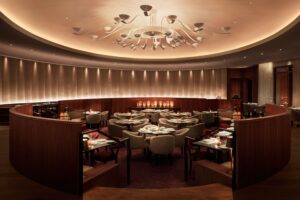
Restaurant projects frequently require furniture to be manufactured specifically for the interior design.
Standard furniture dimensions, materials or finishes may not match the required concept.
Customization may involve:
- Furniture dimensions
- Table shapes
- Chair proportions
- Seat heights
- Wood species
- Veneer
- Metal finishes
- Stone tabletops
- Upholstery
- Fabric and leather
- Decorative details
- Banquette dimensions
- Bar counter construction
The manufacturer should be able to translate the designer’s concept into furniture that can be manufactured consistently.
This becomes especially important when a restaurant contains several furniture types that need to share the same materials, colors or design details.
4. Check Furniture Construction and Commercial Durability
Restaurant furniture should be designed for the frequency of use expected in a commercial environment.
For seating, important considerations may include:
- Frame construction
- Joint strength
- Structural stability
- Seat support
- Foam
- Upholstery
- Stitching
- Glides and feet
For tables, buyers should consider:
- Base stability
- Tabletop construction
- Edge details
- Surface durability
- Connection between the top and base
- Floor leveling
Furniture should also be appropriate for how restaurant staff actually use the space.
Dining chairs may be moved many times each day, while tables may be repeatedly rearranged for different party sizes. Materials and construction should therefore be evaluated according to the intended operating environment rather than appearance alone.
5. Review Materials and Finishes
Restaurant furniture can combine many different materials within one project.
Common materials include:
- Solid wood
- Natural veneer
- Engineered panels
- Laminate
- Metal
- Stone
- Sintered stone
- Glass
- Fabric
- Leather
- Performance upholstery materials
Material selection should consider design intent together with durability, cleaning and maintenance.
Tabletops, for example, require particular attention because they are exposed to food, beverages and frequent cleaning. Upholstery should be selected according to the expected level of use and maintenance requirements.
The manufacturer should be able to reproduce approved colors and finishes consistently across dining chairs, tables, banquettes, bar furniture and other customized products.
6. Evaluate Dining Chair Comfort and Ergonomics
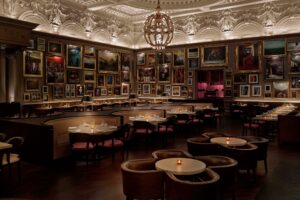
Dining chairs are one of the most important furniture categories in a restaurant.
A chair may look attractive in a rendering but still be unsuitable if the seat height, depth, back angle or cushioning is uncomfortable.
Important factors can include:
- Seat height
- Seat depth
- Seat width
- Backrest angle
- Armrest height
- Cushioning
- Table clearance
- Overall chair dimensions
The correct dimensions also depend on the dining table and intended restaurant format.
Fine dining venues may prioritize longer seating comfort, while high-turnover dining concepts may require a different balance between comfort, footprint and operational efficiency.
For customized restaurant chairs, physical prototypes are useful for reviewing both appearance and comfort before mass production.
7. Check Table Stability and Functional Requirements
Restaurant tables need to support both the design concept and daily operations.
Table specifications should consider:
- Tabletop size
- Tabletop thickness
- Base dimensions
- Base weight
- Structural stability
- Leg position
- Guest legroom
- Floor leveling
- Cleaning requirements
The relationship between tables and chairs should also be checked carefully.
An attractive table base can become impractical if it restricts guest legroom or prevents chairs from being positioned correctly.
Restaurants may also require different table configurations for two-person, four-person or larger dining groups. The manufacturer should understand how these products will function together within the overall seating plan.
8. Review Banquette and Booth Seating Capability
Banquette seating is common in restaurants because it can combine space efficiency, comfort and strong visual identity.
However, customized banquettes require more technical coordination than standard loose furniture.
Important considerations include:
- Site dimensions
- Seat height
- Seat depth
- Backrest angle
- Upholstery construction
- Foam specification
- Wall interfaces
- Floor conditions
- Electrical requirements where applicable
- Removable access panels where required
Curved or irregular banquettes may require particularly accurate drawings and templates.
Because banquettes are often integrated into the interior architecture, the manufacturer may also need to coordinate with the local fit-out or joinery contractor.
9. Evaluate Bar Furniture and Custom Joinery Capability
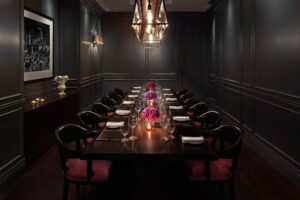
Restaurants with bars or lounge areas may require a combination of loose furniture and fixed joinery.
The scope can include:
- Bar stools
- High tables
- Lounge chairs
- Sofas
- Bar counters
- Back bars
- Display shelving
- Service counters
- Storage
- Decorative joinery
Bar counters and back bars may combine wood, metal, stone, glass, lighting and hardware.
These products require detailed coordination because they can interface with electrical services, equipment and site finishes.
If the restaurant furniture manufacturer is also responsible for fixed furniture, buyers should confirm its shop drawing, engineering and joinery capabilities before production begins.
10. Review Shop Drawing and Engineering Support
Interior design drawings communicate the overall concept, but customized restaurant furniture usually requires more detailed production information.
Shop drawings may define:
- Dimensions
- Construction
- Materials
- Joinery
- Upholstery details
- Metal components
- Stone details
- Hardware
- Finishes
- Installation interfaces
This is especially important for banquettes, bar counters, back bars, buffet counters, service stations and other fixed furniture.
Technical issues should be identified during drawing development rather than after products enter mass production.
The manufacturer should also maintain clear revision records when the designer or project team makes changes.
11. Approve Samples Before Mass Production
Samples allow the project team to verify design and manufacturing details before larger quantities are produced.
Depending on the project, the approval process may include:
- Wood finish samples
- Metal finish samples
- Stone samples
- Fabric and leather samples
- Hardware samples
- Dining chair prototypes
- Table prototypes
- Banquette samples
For dining chairs and lounge seating, prototypes are particularly useful because comfort cannot be fully evaluated from drawings.
Approved samples should become reference standards for production and quality inspection.
For projects involving multiple restaurant locations or large quantities, this process also helps maintain consistency between production batches.
12. Check Production Capacity and Quality Control
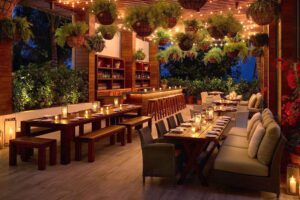
Restaurant projects may combine large quantities of repeated dining chairs with small quantities of highly customized feature furniture.
The manufacturer should be able to manage both types of production within the required project schedule.
Quality control may include:
- Dimensional inspection
- Structural checks
- Table stability
- Chair stability
- Joinery inspection
- Finish comparison
- Upholstery inspection
- Stitching inspection
- Hardware checks
- Assembly inspection
- Final appearance
For batch production, approved drawings and physical samples should remain the reference throughout manufacturing.
This is particularly important when the same dining chair, table or bar stool is produced in large quantities.
13. Consider Cleaning, Maintenance and Replacement
Commercial restaurant furniture should also be evaluated from an operational perspective.
The restaurant team may need to clean tables and seating several times every day. Over time, some components may also need repair or replacement.
Furniture design should therefore consider:
- Cleanable surfaces
- Stain resistance
- Accessible maintenance
- Replaceable glides
- Replaceable upholstery where appropriate
- Hardware access
- Durable edge details
- Suitable finishes for frequent cleaning
A material that looks attractive during sample approval may not be suitable if it is difficult to maintain in daily restaurant operations.
Design, manufacturing and maintenance should therefore be considered together.
14. Clarify Packaging, Delivery and Installation
Furniture manufacturing is only one part of a commercial restaurant project.
Before confirming an order, responsibilities should be clarified for:
- Export packaging
- Product labeling
- Shipping
- Site receiving
- Unloading
- Storage
- Furniture assembly
- Loose furniture placement
- Banquette installation
- Bar and joinery installation
- Final inspection
For international projects, furniture can be manufactured in China while fixed furniture and joinery are installed by a local contractor.
A practical installation structure can be defined as:
Client / Local Contractor
Clear product labels can also help the site team identify furniture according to restaurant area, item number or installation location.
15. Restaurant Furniture Manufacturer Evaluation Checklist
Before selecting a restaurant furniture manufacturer, buyers should confirm:
- Does the manufacturer have relevant restaurant or hospitality project experience?
- Can it manufacture both loose and fixed restaurant furniture?
- Can furniture be customized according to project drawings?
- Does it understand commercial durability requirements?
- Can it coordinate wood, metal, stone and upholstery?
- Can it develop production-ready shop drawings?
- Can it produce dining chair and table prototypes?
- Can it manufacture customized banquettes and booth seating?
- Does it have bar counter and joinery capability where required?
- Can approved finishes be reproduced consistently?
- Are quality-control procedures established for batch production?
- Can packaging and delivery be organized for international projects?
- Are installation responsibilities clearly defined?
The appropriate manufacturer should be able to support both the design requirements and the operational demands of the completed restaurant.
From Restaurant Design to Project Delivery
Choosing a restaurant furniture manufacturer should involve more than comparing catalogs and unit prices.
A custom commercial project typically follows a coordinated process:
Project Brief → Furniture Schedule → Technical Review → Shop Drawings → Material Selection → Prototype → Approval → Manufacturing → Quality Control → Packaging → Delivery → Installation Coordination
Each stage helps translate the restaurant designer’s concept into furniture that can be manufactured consistently and used in a commercial dining environment.
Craftell Home works as a Custom Furniture Manufacturer & FF&E Project Supplier, supporting restaurant and hospitality projects with custom dining tables, dining chairs, banquette seating, lounge sofas, lounge chairs, side tables, bar stools, bar counters and other custom furniture and joinery.
Restaurant Furniture Procurement Questions
What furniture is normally included in a restaurant furniture package?
A restaurant furniture package may include dining tables, dining chairs, banquette and booth seating, lounge sofas, lounge chairs, coffee tables, side tables, bar stools, bar counters, back bars, buffet counters, service furniture and other customized furniture depending on the project.
What should buyers provide when requesting a restaurant furniture quotation?
Useful information includes furniture drawings, dimensions, quantities, furniture schedules or BOQ, materials, finishes, fabrics, reference images, project destination and required delivery schedule.
Can restaurant furniture be customized from interior design drawings?
Yes. Custom furniture manufacturers can develop furniture according to project drawings, specifications and approved materials. Detailed shop drawings should normally be confirmed before production.
Why should dining chair prototypes be approved before mass production?
A prototype allows the project team to check dimensions, comfort, proportions, construction, materials, finishes and upholstery before the design is repeated across a larger production quantity.
What materials are suitable for commercial restaurant furniture?
The appropriate materials depend on the design and operating environment. Common options include solid wood, veneer, engineered panels, metal, stone, sintered stone, glass, commercial upholstery fabrics and leather.
What should be considered when specifying restaurant tables?
Important considerations include tabletop material, dimensions, base stability, legroom, floor leveling, cleaning requirements and compatibility with the selected dining chairs.
Can a furniture manufacturer produce custom restaurant banquettes?
Yes, provided it has suitable upholstery, engineering and fixed-furniture capability. Banquettes should be developed according to site dimensions, seating ergonomics, materials and installation conditions.
Can restaurant furniture be manufactured in China and installed locally?
Yes. For international projects, loose and fixed restaurant furniture can be manufactured in China, while installation—particularly for banquettes, bar counters and fixed joinery—can be completed by a local contractor using approved drawings and installation information.
Material Traceability Reference
Where FSC-certified wood is specified, review the product claim and chain-of-custody documentation against the project requirement. FSC certification addresses forest-based material traceability; it does not replace furniture construction or workmanship inspection.
Published by Craftell Home · Custom Furniture Manufacturer & FF&E Project Supplier
Related restaurant furniture project
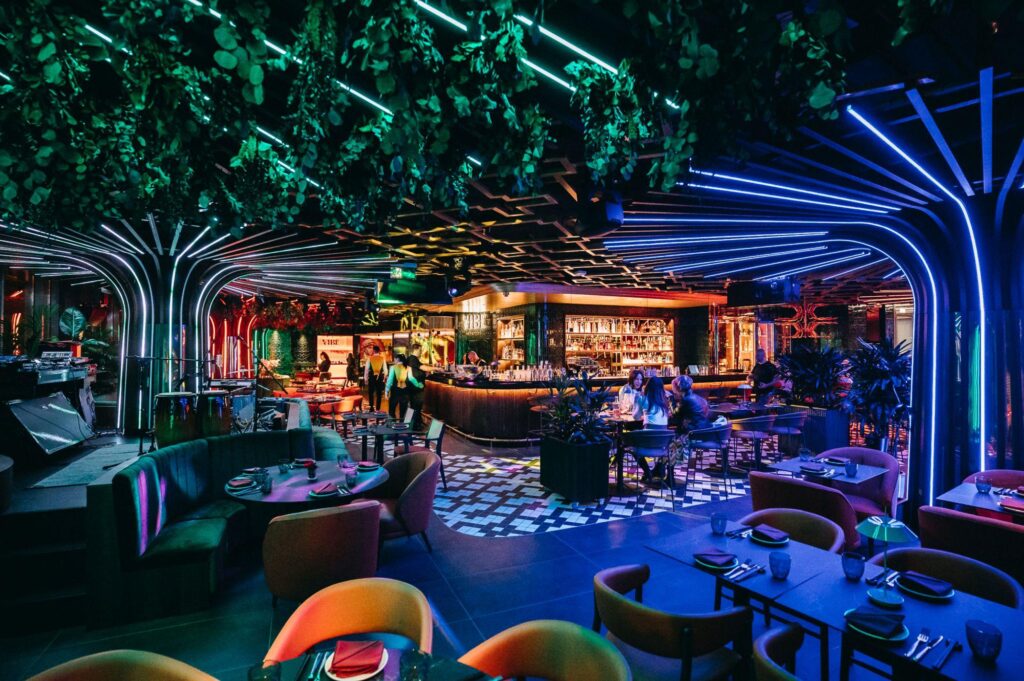
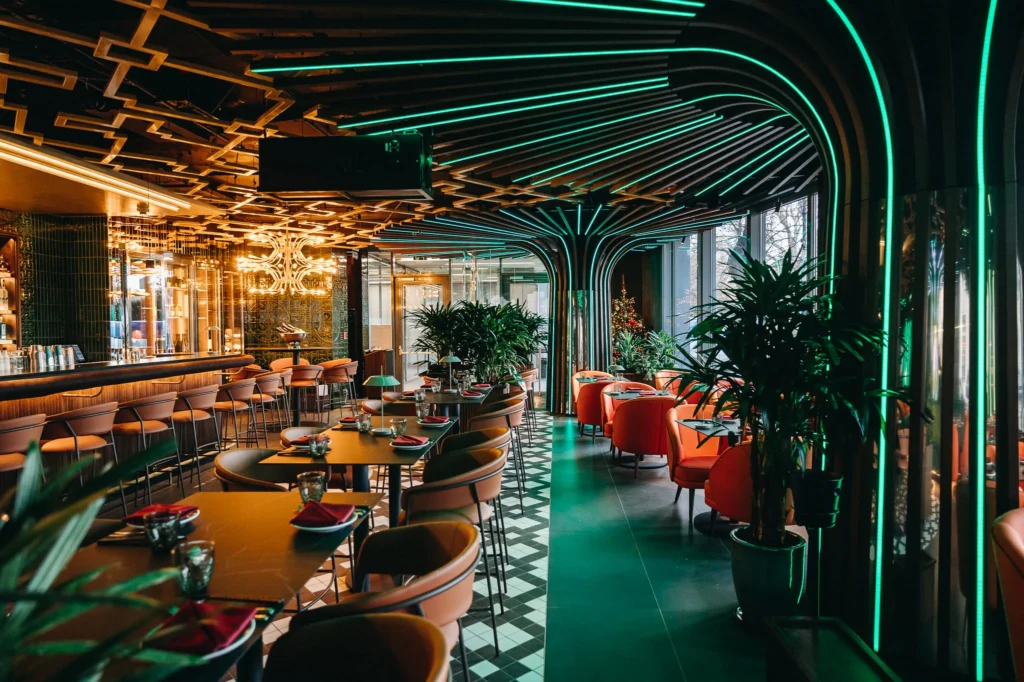
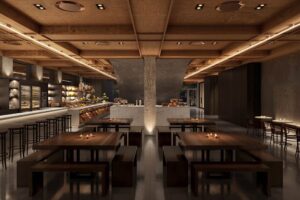
Our published VIBE Budapest project describes the supply of dining tables and chairs, banquette seating, lounge furniture and bar stools. Review the stated supply scope when assessing its relevance to your own project.
This article provides manufacturing and procurement guidance. The final product configuration, acceptance criteria and delivery scope are defined by the approved drawings, specifications, samples and order documents for each project.
Explore Restaurant Furniture Project Resources
Continue with our restaurant furniture solutions and selected projects.