Commercial Restaurant Furniture Buying Guide: Chairs, Tables, Booths & Bar Seating
Confirm the chair seat height against the table underside and check whether the table base interferes with seating. For upholstered dining chairs, assess the frame, seams and cleaning requirements alongside the appearance.
Commercial restaurant furniture needs to balance design, comfort, durability and daily operational requirements. Dining chairs may be used by dozens of guests every day, tables are frequently cleaned and repositioned, booth seating must fit the restaurant layout accurately, and bar stools need to remain stable and comfortable under continuous commercial use.
For restaurant owners, hotel groups, developers, designers and FF&E procurement companies, furniture selection should therefore go beyond appearance. Dimensions, construction, materials, seating comfort, table stability, cleaning, maintenance and quantity all influence whether a product is suitable for a commercial dining environment.
This guide explains how to specify and purchase the main furniture categories used in restaurants, including dining chairs, dining tables, booth and banquette seating, bar stools and lounge furniture.
Compare Chairs and Tables as a Working Pair
Confirm the chair seat height against the table underside and check whether the table base interferes with seating. For upholstered dining chairs, assess the frame, seams and cleaning requirements alongside the appearance.
Craftell Home develops custom seating and tables to the agreed project specification. A representative approved sample gives production and inspection a more useful reference than a style photograph alone.
1. Start with the Restaurant Layout and Seating Plan
Furniture selection should begin with the restaurant layout rather than individual product styles.
The seating plan determines how many guests the restaurant can accommodate and how the furniture needs to function within the available space.
| ✓ Dining area dimensions | ✓ Required seating capacity |
| ✓ Table sizes and combinations | ✓ Chair dimensions |
| ✓ Booth and banquette locations | ✓ Bar seating |
| ✓ Guest circulation | ✓ Service circulation |
| ✓ Access to tables | ✓ Clearance around fixed furniture |
Furniture that is too large can reduce circulation and seating capacity, while furniture that is too small may create uncomfortable proportions or fail to match the intended restaurant positioning.
Tables, chairs and fixed seating should therefore be coordinated as part of the complete restaurant layout.
2. Choose Dining Chairs for Commercial Use
Dining chairs are among the most frequently used furniture items in a restaurant. Appearance is important, but dimensions, comfort, construction and durability should be evaluated together.
| ✓ Seat height | ✓ Seat depth |
| ✓ Seat width | ✓ Overall width |
| ✓ Backrest angle | ✓ Armrest height |
| ✓ Frame construction | ✓ Structural stability |
| ✓ Upholstery | ✓ Furniture weight |
The relationship between the chair and dining table is particularly important. Armchairs, for example, require sufficient clearance beneath or around the tabletop.
Furniture weight also affects restaurant operations. Very heavy chairs can be difficult for staff and guests to move, while lighter chairs still need sufficient structural stability for frequent commercial use.
For customized dining chairs, a physical prototype provides an opportunity to review proportions, comfort, construction and finish before mass production.
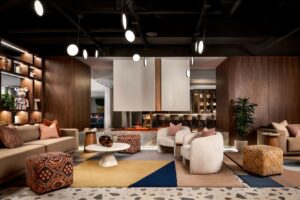
3. Select the Right Dining Tables
Restaurant tables need to support daily dining operations while fitting the overall interior design.
| ✓ Tabletop dimensions | ✓ Tabletop material |
| ✓ Table height | ✓ Base construction |
| ✓ Base stability | ✓ Guest legroom |
| ✓ Edge details | ✓ Floor leveling |
| ✓ Cleaning requirements | ✓ Seating configuration |
Table bases deserve particular attention. A visually attractive base can create operational problems if it restricts guest legroom or prevents chairs from being positioned correctly.
Restaurants may also use combinations of two-person and four-person tables that can be rearranged for larger groups. In this situation, dimensions and base positions should allow the tables to function both independently and when combined.
4. Compare Restaurant Tabletop Materials
Restaurant tabletops are exposed directly to food, beverages, cleaning products and repeated daily use. Material selection should therefore consider appearance, durability and maintenance together.
Common options include:
| Solid Wood | Natural appearance with suitable commercial surface finishing |
| Natural Veneer | Wood appearance with flexible construction possibilities |
| HPL / Laminate | Practical surface option for many high-use environments |
| Stone | Premium appearance with weight and support considerations |
| Sintered Stone | Durable decorative surface for appropriate applications |
| Glass | Suitable for selected designs with appropriate specifications |
Different restaurant areas can use different tabletop materials according to their design and operational requirements rather than applying one material throughout the entire project.
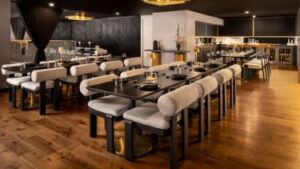
5. Specify Booth and Banquette Seating
Booth and banquette seating can improve seating efficiency while creating a strong architectural feature within a restaurant.
Unlike loose chairs, fixed seating normally needs to be developed according to actual site dimensions.
| ✓ Overall dimensions | ✓ Seat height |
| ✓ Seat depth | ✓ Backrest angle |
| ✓ Foam construction | ✓ Upholstery material |
| ✓ Wall interfaces | ✓ Floor conditions |
| ✓ Table relationship | ✓ Installation method |
Straight banquettes are generally easier to coordinate, while curved, corner or irregular seating requires more detailed drawings and site information.
Comfort is equally important. A visually impressive banquette can still perform poorly if the seat depth, backrest angle or relationship with the dining table is incorrect.
For custom projects, shop drawings should be approved before production.
6. Understand Booth Seating Construction
Commercial booth seating usually combines several structural and decorative components.
| • Internal frame | • Seat support |
| • Foam | • Upholstery |
| • Decorative stitching | • Timber or metal details |
| • Plinth or base | • Wall panels |
| • Integrated dividers | • Removable access panels |
Some restaurant banquettes may also integrate electrical outlets, lighting or other building services.
These details need to be coordinated with the interior designer and local contractor before production. For international projects, accurate drawings are particularly important when the banquette is manufactured remotely and installed by a local fit-out or joinery team.
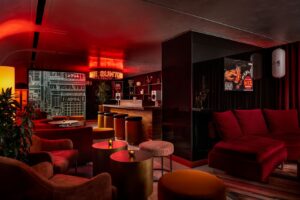
7. Choose Bar Stools and Bar Seating
Bar stools have different ergonomic requirements from standard dining chairs. The first consideration is the relationship between seat height and the finished bar or counter height.
| ✓ Seat height | ✓ Counter height |
| ✓ Footrest position | ✓ Back support |
| ✓ Seat width | ✓ Structural stability |
| ✓ Upholstery | ✓ Floor protection |
| ✓ Furniture weight | ✓ Ease of movement |
A stool that looks appropriate in a rendering may still be uncomfortable if its proportions do not match the counter.
Footrest position is particularly important because guests cannot place their feet directly on the floor when seated at bar height.
For upholstered bar stools, materials should also be selected according to the expected level of use and cleaning.
8. Select Lounge Furniture for Restaurant and Bar Areas
Many restaurants include lounge areas in addition to traditional dining seating.
Typical furniture may include:
| • Lounge sofas | • Lounge chairs |
| • Armchairs | • Coffee tables |
| • Side tables | • Low dining tables |
Lounge furniture creates a more relaxed seating environment but still needs to support commercial use.
Seat height and table height should be coordinated according to how the area will function. A lounge designed mainly for drinks has different requirements from a low-seating area where guests are expected to eat complete meals.
For hotel restaurants and bars, lounge furniture may also need to coordinate visually with adjacent lobbies and public areas.
9. Choose Upholstery for Restaurant Furniture
Fabric and leather selection affects appearance, comfort, maintenance and furniture cost.
| ✓ Expected frequency of use | ✓ Cleaning requirements |
| ✓ Abrasion performance | ✓ Stain resistance |
| ✓ Color and pattern | ✓ Fabric width |
| ✓ Pattern repeat | ✓ Project requirements |
Dining chairs, bar stools, banquettes and lounge seating do not necessarily require the same upholstery specification.
For example, a decorative lounge chair used occasionally may have different operational requirements from a restaurant banquette used continuously throughout lunch and dinner service.
Where specific performance or fire requirements apply, they should be confirmed according to the project specification, furniture category and destination market.
10. Coordinate Materials and Finishes
A restaurant may contain many furniture categories, but they should still feel like part of one coordinated interior.
A typical project can combine:
| • Wood finishes | • Natural veneer |
| • Painted surfaces | • Metal finishes |
| • Stone | • Glass |
| • Fabric | • Leather |
| • Decorative hardware | • Other project finishes |
Approved material and finish samples help maintain consistency across dining chairs, tables, booths, bar stools, lounge furniture and fixed joinery.
This becomes particularly important when different furniture categories are manufactured at different stages.
Material references should remain clearly identified throughout sampling and mass production.
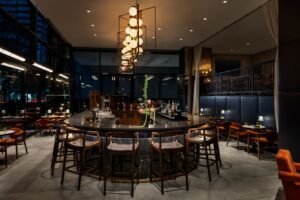
11. Check Commercial Furniture Durability
Restaurant furniture is exposed to more frequent use than most residential furniture.
Buyers should review construction and durability according to the actual restaurant operating environment.
| ✓ Frame construction | ✓ Joint strength |
| ✓ Chair stability | ✓ Table stability |
| ✓ Upholstery workmanship | ✓ Edge protection |
| ✓ Hardware | ✓ Surface finish |
| ✓ Glides and feet | ✓ Overall workmanship |
Durability should not be evaluated simply by making furniture heavier or using more material.
Appropriate construction, suitable joints, correct materials and consistent manufacturing are more important than weight alone.
12. Consider Cleaning and Maintenance
Restaurant furniture is cleaned frequently, making maintenance an important purchasing consideration.
Table surfaces should be suitable for repeated cleaning, while upholstery should be selected according to the operating environment. Furniture details should also avoid unnecessarily difficult-to-clean areas where possible.
Frequently used or replaceable components may include:
| • Chair glides | • Adjustable feet |
| • Hardware | • Seat cushions |
| • Upholstery panels | • Table bases |
Maintenance considerations become especially important when a project purchases large quantities of the same furniture because a small operational problem can be repeated across the entire restaurant.
13. Approve Samples Before Placing a Large Order
Drawings and renderings cannot fully communicate furniture comfort, finish quality or physical proportions.
For customized restaurant furniture, sample approval may include:
| • Material samples | • Finish samples |
| • Fabric and leather samples | • Dining chair prototype |
| • Bar stool prototype | • Table prototype |
| • Banquette sample |
A prototype allows the buyer and designer to evaluate the product physically before mass production.
For seating, the review should include comfort and ergonomics in addition to appearance.
Once approved, the physical sample can become the production and quality-control reference for the remaining quantity.
14. Check Quality Before Shipment
Quality control should be based on approved drawings, materials and physical samples.
For restaurant furniture, inspection may include:
| ✓ Dimensional inspection | ✓ Structural checks |
| ✓ Table stability | ✓ Chair stability |
| ✓ Joinery inspection | ✓ Finish comparison |
| ✓ Upholstery inspection | ✓ Stitching inspection |
| ✓ Hardware checks | ✓ Assembly inspection |
| ✓ Final appearance | ✓ Quantity and labeling |
For batch production, inspection should confirm that repeated dining chairs, tables, bar stools and other furniture remain consistent with the approved standard.
Problems identified before packaging are generally easier to correct than problems discovered after furniture reaches the restaurant site.
15. Plan Quantities and Spare Furniture
Furniture quantities should be calculated from the approved seating plan and furniture schedule.
Operational requirements may also justify purchasing additional quantities of certain loose products.
These can include:
| • Dining chairs | • Bar stools |
| • Small tables | • Replaceable components |
The appropriate spare quantity depends on the size of the restaurant, furniture type and operating requirements.
For customized furniture using project-specific finishes or fabrics, future replacement can become more difficult if the original materials are no longer available.
Planning this during procurement can simplify future restaurant operations.
16. Consider Packaging, Delivery and Installation
For international restaurant projects, furniture needs to move from the factory to the project site without damage and in a sequence that supports installation.
Packaging labels may identify:
| • Project name | • Item number |
| • Furniture description | • Restaurant area |
| • Quantity | • Package number |
Loose furniture may require unpacking, assembly and positioning.
Fixed banquettes, bar counters and other joinery require closer coordination with site dimensions and the local installation team.
A common international project structure is:
Manufacturing in China → Export Packaging → International Shipping → Local Site Delivery → Local Joinery / Fit-Out Installation
Installation responsibility can be defined according to the project as:
Client / Local Contractor
17. Restaurant Furniture Buying Checklist
Before placing a commercial restaurant furniture order, buyers should confirm:
| ✓ Furniture dimensions | ✓ Required quantities |
| ✓ Dining chair comfort | ✓ Table and chair compatibility |
| ✓ Table stability | ✓ Booth dimensions |
| ✓ Bar stool and counter heights | ✓ Materials and finishes |
| ✓ Upholstery specification | ✓ Commercial durability |
| ✓ Cleaning requirements | ✓ Approved prototypes |
| ✓ Quality requirements | ✓ Packaging requirements |
| ✓ Delivery schedule | ✓ Installation responsibility |
A structured furniture schedule makes it easier to coordinate purchasing, manufacturing and installation across the complete restaurant project.
From Furniture Selection to Restaurant Opening
Commercial restaurant furniture purchasing should balance aesthetics with the practical requirements of daily operation.
A structured procurement process can follow:
Restaurant Layout → Furniture Schedule → Product Selection → Dimensions → Materials & Finishes → Prototype → Approval → Production → Quality Control → Packaging → Delivery → Installation
Dining chairs should provide suitable comfort and proportions. Tables need to remain stable and practical. Booth seating should fit the site accurately. Bar stools need to coordinate with counter heights, while materials and finishes need to support frequent commercial use and maintenance.
For custom restaurant projects, evaluating these requirements as one coordinated furniture package can help maintain consistency across dining, bar and lounge areas.
Craftell Home works as a Custom Furniture Manufacturer & FF&E Project Supplier, providing customized restaurant furniture including dining tables, dining chairs, banquette and booth seating, lounge sofas, lounge chairs, side tables, bar stools, bar counters and other custom furniture and joinery for international hospitality and commercial projects.
Restaurant Furniture Procurement Questions
What furniture is typically needed for a commercial restaurant?
A restaurant may require dining tables, dining chairs, booth or banquette seating, bar stools, lounge sofas, lounge chairs, coffee tables, side tables, bar counters and other fixed furniture depending on the layout and concept.
What should I consider when buying restaurant dining chairs?
Consider dimensions, seat height, comfort, frame construction, stability, upholstery, furniture weight, cleaning requirements and compatibility with the selected dining tables.
What should I look for when buying restaurant tables?
Review tabletop dimensions and materials, base stability, guest legroom, floor leveling, cleaning requirements and whether tables need to be combined for different group sizes.
What is the difference between booth seating and loose restaurant seating?
Loose chairs can be repositioned, while booth and banquette seating is usually manufactured according to specific site dimensions and may be fixed to the building or integrated with other interior elements.
How do I choose the correct bar stool height?
Bar stool seat height should be selected according to the finished counter or bar height, with sufficient space between the seat and underside of the counter for comfortable seating.
Should I order a prototype before buying restaurant furniture in quantity?
For customized products, especially dining chairs, bar stools and other seating, a prototype is useful for checking dimensions, comfort, construction, materials and finishes before mass production.
Which materials are suitable for restaurant furniture?
The appropriate materials depend on the design and operating environment. Common options include solid wood, veneer, engineered panels, laminate, metal, stone, sintered stone, glass, fabric and leather.
Can restaurant furniture be manufactured in China for an overseas project?
Yes. Furniture can be manufactured and packaged in China for international delivery. Fixed furniture such as banquettes and bar counters can then be installed by a local joinery or fit-out contractor according to the approved project drawings.
Published by Craftell Home · Custom Furniture Manufacturer & FF&E Project Supplier
Related restaurant furniture project
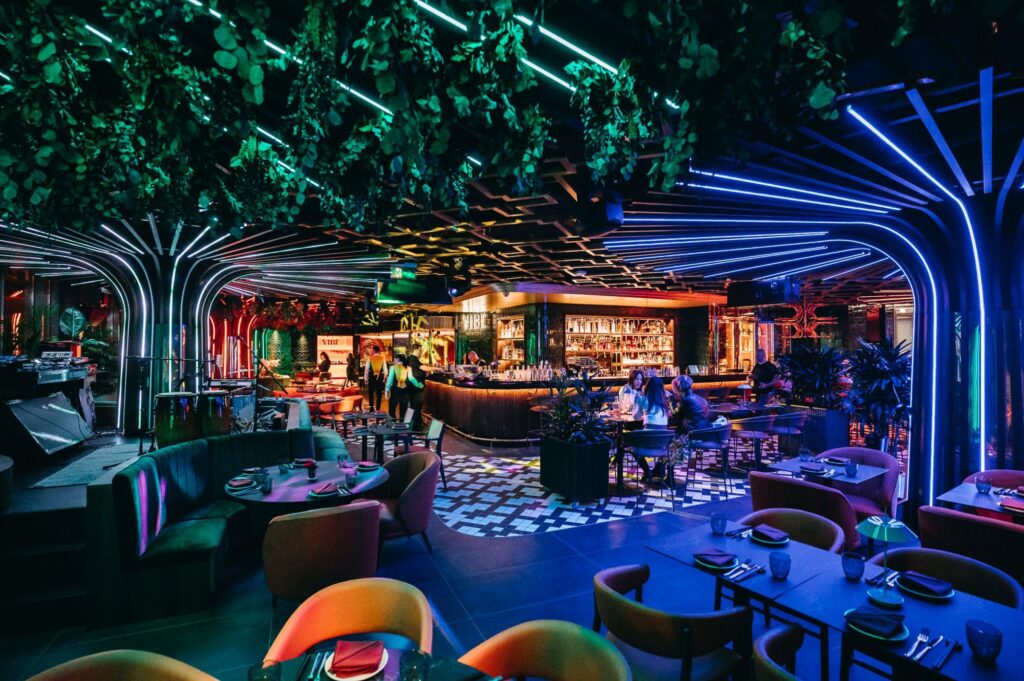
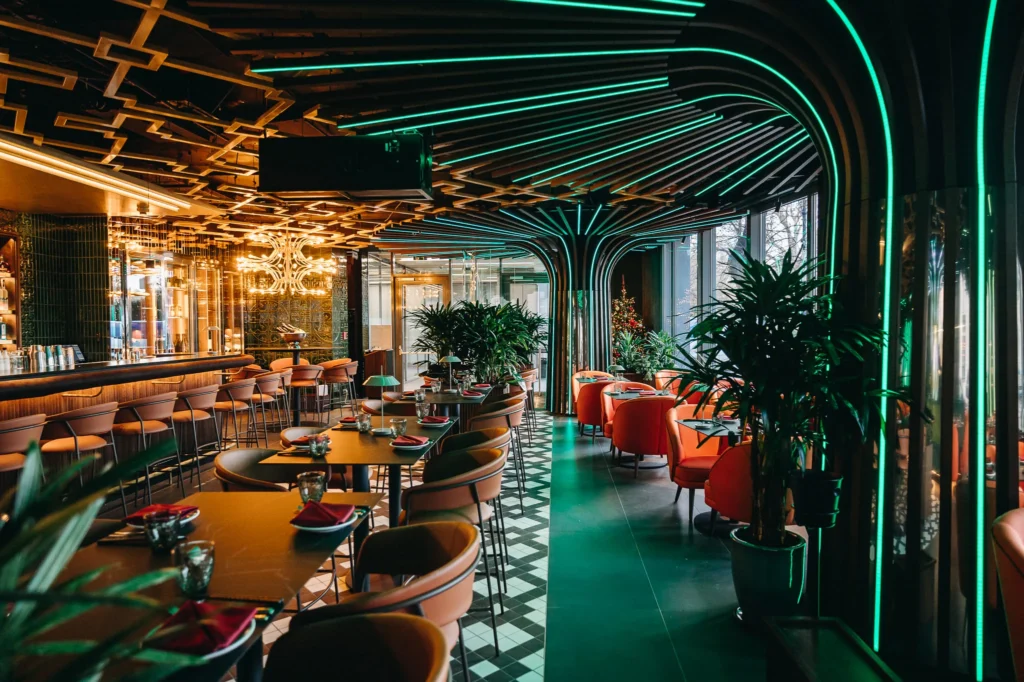
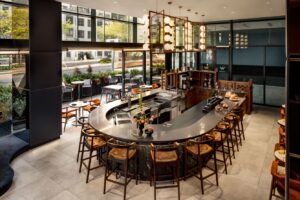
Our published VIBE Budapest project describes the supply of dining tables and chairs, banquette seating, lounge furniture and bar stools. Review the stated supply scope when assessing its relevance to your own project.
This article provides manufacturing and procurement guidance. The final product configuration, acceptance criteria and delivery scope are defined by the approved drawings, specifications, samples and order documents for each project.
Explore Restaurant Furniture Project Resources
Continue with our restaurant furniture solutions and selected projects.