How to Choose an Apartment Furniture Manufacturer for Multi-Unit Projects
Inspect a representative bed, sofa or chair against the intended dimensions and material specification. Check construction and upholstery details as well as appearance, then record the approved version for repeated production.
Multi-unit apartment projects require a different furniture procurement strategy from single residences. Instead of developing furniture for one home, the project team must coordinate multiple unit types, repeated furniture items, different room layouts, shared material standards, production quantities, packing requirements and delivery sequences across the entire development.
A suitable apartment furniture manufacturer should therefore provide more than individual furniture products. The manufacturer needs the technical, production and project-management capability to convert apartment layouts, furniture schedules and design specifications into a controlled manufacturing package that can be repeated consistently across dozens or hundreds of units.
The following factors should be evaluated when selecting an apartment furniture manufacturer for a multi-unit residential project.
Evaluate a Repeated Item Before the Full Order
Inspect a representative bed, sofa or chair against the intended dimensions and material specification. Check construction and upholstery details as well as appearance, then record the approved version for repeated production.
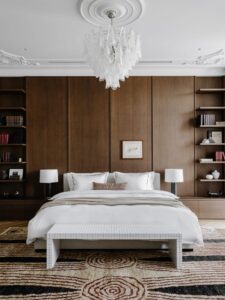
Beds, sofas and lounge chairs are established development categories for Craftell Home. An existing construction can reduce redevelopment, but project dimensions, upholstery and comfort still need approval.
1. Define the Apartment Furniture Scope First
Before comparing manufacturers, define exactly what the apartment furniture package includes.
A multi-unit apartment furniture package can cover:
| Furniture & FF&E | Fixed Interiors & Supporting Products |
|---|---|
| Living room furniture | Wardrobes |
| Dining room furniture | Built-in cabinets |
| Bedroom furniture | Vanities |
| Mattresses | Wall panels |
| Custom rugs | Storage units |
| Decorative lighting | Outdoor furniture |
| Artwork | Interior decorative accessories |
The scope should also identify whether furniture is required only for residential units or also for reception areas, lounges, shared amenities and other common spaces.
A clear scope allows manufacturers to quote the same package and reduces omissions during procurement.
2. Organize the Project by Unit Type
Apartment developments usually contain several unit configurations, such as studios, one-bedroom apartments, two-bedroom apartments, three-bedroom apartments and penthouses.
Each unit type should have its own furniture schedule.
For example:
| Unit Type | Typical Furniture Planning |
|---|---|
| Studio | Living/sleeping furniture, dining furniture, storage |
| 1-Bedroom | Living, dining and one bedroom package |
| 2-Bedroom | Living, dining and two bedroom packages |
| 3-Bedroom | Larger living/dining package and three bedrooms |
| Penthouse | Larger-scale or more customized furniture package |
This structure makes it easier to calculate quantities, manage drawings and control packing later in the project.
3. Check Experience with Multi-Unit Residential Projects
A manufacturer that can produce furniture for one private residence is not automatically prepared for a multi-unit development.
Apartment projects require repeated manufacturing across many units while maintaining consistent dimensions, materials, finishes and construction standards.
Relevant experience should demonstrate the ability to manage:
| Project Requirement | Manufacturer Capability |
|---|---|
| Multiple apartment types | Separate unit schedules |
| Repeated furniture | Batch production control |
| Custom dimensions | Drawing-based manufacturing |
| Large quantities | Production planning |
| Multiple product categories | Coordinated manufacturing |
| International delivery | Export packing and documentation |
Project experience should be evaluated according to similarity of scope and complexity rather than project name alone.
4. Evaluate Custom Manufacturing Capability
Apartment furniture frequently needs to fit specific layouts rather than standard retail dimensions.
Sofas may need different lengths for different unit types. Dining tables may need to fit restricted dining zones. Beds, bedside tables, desks and TV units may need dimensions coordinated with walls, doors, windows and circulation.
A suitable manufacturer should be able to customize:
| Product Element | Customization |
|---|---|
| Dimensions | Width, depth and height |
| Materials | Veneer, solid wood, panels, metal, stone, glass |
| Finishes | Stain, paint, lacquer, metal finish |
| Upholstery | Fabric, leather, stitching and cushion construction |
| Hardware | Hinges, runners, handles and fittings |
| Construction | Product-specific structural requirements |
Customization should be controlled through drawings and specifications rather than informal instructions.
5. Review Technical Drawing Capability
Technical drawings are particularly important when the same furniture item will be repeated across multiple apartments.
Before production, drawings should clearly identify:
- Overall dimensions
- Material specifications
- Finish references
- Construction details
- Upholstery details
- Hardware
- Stone, metal or glass details
- Item codes
- Unit-type references
The drawing should correspond with the BOQ and furniture schedule so that one product cannot be confused with another during production.
6. Coordinate Furniture with Apartment Layouts
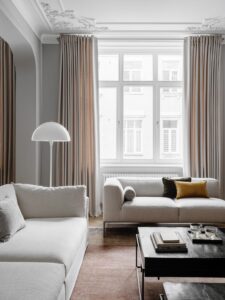
Furniture dimensions should be checked against the actual apartment layouts before production.
The manufacturer should review the relationship between furniture and:
| Area | Coordination Points |
|---|---|
| Living Room | Sofa size, TV position, tables and circulation |
| Dining Area | Table dimensions, chair clearance and nearby circulation |
| Bedroom | Bed, bedside tables, wardrobe and desk positions |
| Entrance | Console, storage and circulation |
| Balcony | Furniture dimensions and door clearance |
This becomes increasingly important when different unit types use similar furniture with different dimensions.
7. Control Similar Products Across Different Unit Types
A common apartment procurement challenge is that furniture can look almost identical while having different dimensions.
For example, the same sofa design may be produced in two lengths for one-bedroom and two-bedroom units.
Product codes should distinguish these variations clearly.
A structured coding system can connect:
Unit Type → Room → Item Code → Drawing → BOQ → Production → QC → Packing
This reduces the risk of producing or delivering the wrong version.
8. Evaluate Loose Furniture Manufacturing Capability
Loose furniture usually represents a significant portion of an apartment furniture package.
Typical categories include:
| Living & Dining | Bedroom |
|---|---|
| Sofas | Beds |
| Lounge chairs | Bedside tables |
| Coffee tables | Benches |
| Side tables | Desks |
| TV units | Desk chairs |
| Dining tables | Lounge chairs |
| Dining chairs | Dressers / storage furniture |
The manufacturer should demonstrate suitable capability across upholstery, woodworking, metalwork and mixed-material furniture rather than specializing in only one category.
9. Evaluate Fixed Interior Capability Separately
When the project includes fixed interiors, they should be treated as a separate technical category.
Apartment fixed interiors can include:
- Wardrobes
- Built-in storage
- TV cabinets
- Vanities
- Wall panels
- Headboards
- Built-in desks
- Decorative joinery
These products require closer coordination with architectural dimensions and site conditions than loose furniture.
Craftell Home’s scope covers manufacturing, quality control, packing, export and project delivery. On-site installation is not included and is handled by the client or local contractor.
10. Review Material and Finish Management
Multi-unit projects can involve hundreds or thousands of individual furniture pieces. Material control therefore becomes critical.
A typical apartment package can combine:
Wood Veneer → Engineered Panels → Paint → Metal → Stone → Glass → Fabric → Leather → Hardware
Each approved material should have a clear reference.
The manufacturer should be able to reproduce the approved appearance consistently across different production batches.
11. Check Finish Consistency Across Repeated Units
A finish that looks acceptable on one piece can become problematic when repeated across 50 or 100 apartments.
Important control points include:
| Material | Consistency Check |
|---|---|
| Veneer | Color and grain direction |
| Paint / Lacquer | Color, sheen and surface quality |
| Metal | Tone and texture |
| Stone | Approved natural variation |
| Fabric | Color, direction and batch |
| Leather | Color and texture |
| Hardware | Finish and model |
The objective is not to eliminate every natural material variation, but to maintain the approved visual range across the project.
12. Review the Material Approval Process
Approved materials should be connected to identifiable codes rather than descriptions such as “light oak” or “beige fabric.”
A practical approval record should include:
Material Code → Supplier Reference → Color / Finish → Approved Sample → Related Furniture Items
This creates a reference that can be used during production and final quality inspection.
13. Determine Which Products Require Pre-Production Review
Not every item requires the same level of pre-production review.
High-priority products normally include:
- High-quantity repeated items
- Technically complex furniture
- Upholstered products
- Products using several materials
- Items with critical dimensions
- Furniture representing a major visual feature of the apartment
The purpose is to identify construction, dimensional or finish issues before they affect a large production quantity.
14. Evaluate Production Capacity
Production capacity should be evaluated according to the actual apartment project schedule.
A manufacturer may have sufficient factory space but still lack the planning capacity to coordinate multiple furniture categories simultaneously.
Important questions include:
| Production Question | Why It Matters |
|---|---|
| How are repeated items scheduled? | Controls batch production |
| How are different unit types separated? | Prevents product confusion |
| How are material batches controlled? | Supports finish consistency |
| How are production revisions communicated? | Prevents outdated specifications |
| How are completed items tracked? | Supports QC and packing |
Capacity should therefore be considered together with production management.
15. Review the Factory and Manufacturing Process
For significant apartment projects, factory evaluation provides useful information about how the manufacturer actually operates.
Review areas can include:
- Woodworking
- Upholstery
- Finishing
- Metalwork
- Assembly
- Material storage
- Hardware management
- Quality inspection
- Packing
- Finished-goods storage
The objective is to understand whether the production system can support the required product categories and project volume.
16. Examine Quality-Control Procedures
Apartment furniture quality control should follow the approved specification rather than general visual inspection alone.
QC should verify:
| Inspection Area | Typical Checks |
|---|---|
| Dimensions | Width, depth, height |
| Construction | Stability, joints, reinforcement |
| Finish | Color, sheen, surface quality |
| Upholstery | Fabric direction, stitching, comfort |
| Hardware | Function and correct model |
| Mixed Materials | Alignment and interfaces |
| Appearance | Damage, scratches, contamination |
Inspection records should use the same item codes as the BOQ and production drawings.
17. Use First-Off Inspection for Repeated Furniture
Repeated furniture creates efficiency, but it can also multiply mistakes.
If one incorrect bedside table is produced, the issue is manageable. If the same error is repeated across 200 pieces, correction becomes significantly more difficult.
For repeated items, the first completed product should be checked against:
Approved Drawing → Dimensions → Materials → Finish → Construction → Hardware
Only after these points are confirmed should the repeated batch continue.
18. Check Upholstery Construction
Apartment sofas, lounge chairs, dining chairs, beds and benches are frequently used products.
Upholstery evaluation should consider:
- Internal frame construction
- Foam specification
- Cushion structure
- Fabric or leather
- Stitching
- Piping
- Comfort
- Shape retention
- Cleaning and maintenance requirements
For rental apartments and serviced residences, durability can be especially important because furniture experiences repeated occupant turnover.
19. Review Casegoods and Woodworking
Casegoods should be evaluated beyond their external appearance.
Check:
| Component | Review Point |
|---|---|
| Veneer | Selection and grain direction |
| Edges | Clean treatment and durability |
| Drawers | Alignment and operation |
| Doors | Gaps and hardware |
| Stone Tops | Support and edge treatment |
| Metal Details | Alignment and finish |
| Back Panels | Construction and fixing |
| Internal Surfaces | Finish quality |
These details become particularly visible when the same product is installed throughout multiple apartments.
20. Evaluate Project Management Capability
Multi-unit projects generate large amounts of information.
The manufacturer needs to coordinate:
BOQ → Unit Types → Drawings → Materials → Approvals → Production → QC → Packing → Delivery
A project manager should be able to maintain clear records of:
- Current drawings
- Approved finishes
- Quantity revisions
- Unit-type changes
- Production status
- QC status
- Packing status
- Shipment status
Without structured information control, even a capable factory can create avoidable project errors.
21. Check Revision Control
Apartment projects often change during procurement.
Unit quantities can change. Furniture dimensions can be revised. Fabrics can be replaced. Finishes can be updated.
Every revision should identify:
Item Code + Revision Number + Revision Date + Approval Status
Superseded information should be removed from active production documents.
22. Compare Quotations Using the Same Specification
Furniture quotations are only useful when suppliers are pricing the same product specification.
A low quotation can result from differences in:
- Internal construction
- Material grade
- Veneer specification
- Upholstery
- Foam
- Hardware
- Metal thickness
- Stone
- Finish process
- Packing standard
Before comparing prices, normalize the specification.
23. Clarify What the Quotation Includes
A professional quotation should clearly state the commercial scope.
Check:
| Commercial Item | Confirm |
|---|---|
| Furniture | Included product categories |
| Quantity | Per item and project total |
| Materials | Specification basis |
| Finishes | Included finish standard |
| Hardware | Included where applicable |
| Packing | Export packing standard |
| Freight | Included or excluded |
| Taxes / Duties | Included or excluded |
| On-Site Installation | Not included |
| Delivery Terms | Clearly stated |
This reduces commercial disputes later.
24. Evaluate Apartment Furniture by Total Project Cost
Unit price alone should not determine supplier selection.
A more useful comparison considers:
Furniture Cost + Quality Risk + Replacement Risk + Packing Risk + Delivery Risk + Coordination Cost
A slightly lower unit price can become expensive if it creates repeated quality issues across many apartments.
25. Review Packing Standards
Apartment furniture passes through several handling stages before reaching the final unit.
Packing should protect against:
- Surface scratches
- Edge damage
- Corner impact
- Moisture
- Dust
- Abrasion
- Glass or stone breakage
- Hardware loss
Packing methods should vary according to the product and material.
26. Require Unit-Based Packing and Labeling
This is one of the most important differences between apartment projects and individual residential projects.
Packages should be identifiable by:
| Label Information | Example |
|---|---|
| Project | Apartment Development A |
| Unit Type | 2-Bedroom |
| Apartment Number | Unit 1208 |
| Room | Living Room |
| Item Code | LR-SF-01 |
| Package Number | PKG-0187 |
Unit-based labeling helps the receiving team distribute furniture efficiently after delivery.
27. Check Packing Lists Against the BOQ
The packing list should use the same coding structure as the project BOQ.
This creates traceability:
BOQ Item → Unit → Room → Package → Container
If a package is missing or damaged, the project team can identify the affected apartment and furniture item quickly.
28. Evaluate Export and Delivery Capability
For international apartment projects, the manufacturer’s responsibility extends beyond production.
Export coordination should cover:
- Export packing
- Packing lists
- Container planning
- Loading sequence
- Commercial documents
- Shipment records
- Delivery destination
- Project schedule
Furniture should not simply leave the factory; it should leave with documentation that allows the project team to receive and identify it efficiently.
29. Coordinate Container Loading with Project Sequence
Container planning should consider more than maximum volume utilization.
Where practical, loading should reflect:
- Unit type
- Building
- Floor
- Apartment number
- Delivery phase
- Furniture category
This can reduce unnecessary sorting after arrival.
30. Review Communication and Response Quality
Multi-unit furniture procurement involves continuous coordination.
A suitable manufacturer should respond clearly to technical questions, identify unresolved information and maintain written records of important decisions.
Good communication becomes particularly important when the project includes several unit types, multiple materials and a large number of repeated products.
31. Apartment Furniture Manufacturer Evaluation Checklist
Before selecting a supplier, confirm:
| Evaluation Area | Check |
|---|---|
| Multi-unit residential experience | ✓ |
| Custom furniture manufacturing | ✓ |
| Multiple unit-type management | ✓ |
| Technical drawing capability | ✓ |
| Loose furniture capability | ✓ |
| Fixed interior capability | ✓ |
| Material and finish control | ✓ |
| Repeated-item consistency | ✓ |
| Production capacity | ✓ |
| Quality-control procedures | ✓ |
| Revision control | ✓ |
| Unit-based packing and labeling | ✓ |
| Export packing | ✓ |
| International project delivery | ✓ |
| Clear commercial scope | ✓ |
From Apartment Furniture Planning to International Project Delivery
Choosing an apartment furniture manufacturer for a multi-unit project requires more than comparing product appearance and unit prices.
The manufacturer must be able to translate different apartment layouts into controlled furniture schedules, coordinate drawings and materials, reproduce approved finishes across repeated units, manage batch production, inspect completed products and organize packing according to apartment numbers and delivery requirements.
For developers, procurement companies, contractors and FF&E teams, the most effective workflow is:
Apartment Layouts → Unit Types → Furniture Scope & BOQ → Technical Drawings → Material & Finish Approval → Production → Quality Control → Unit-Based Packing → Export Delivery
When these stages are managed as one connected system, furniture procurement becomes easier to control across large residential developments.
Apartment Furniture Procurement Questions
What information should be prepared before requesting an apartment furniture quotation?
Prepare apartment floor plans, unit types, furniture layouts, BOQ, quantities, dimensions, material requirements, finish references, delivery destination and expected project schedule.
Can one furniture design be used across different apartment types?
Yes, where appropriate. However, dimensions and quantities should be checked separately for each unit type. Similar products with different dimensions should use separate item codes.
How should furniture quantities be calculated for a multi-unit project?
First establish the furniture quantity for each unit type, then multiply it by the number of apartments of that type. Common-area furniture should be calculated separately.
Why is unit-based labeling important?
It connects each package to a specific apartment, room and furniture item, making receiving and distribution more efficient and reducing the risk of misplaced products.
How can finish consistency be controlled across many apartments?
Use approved material and finish references, consistent material codes, controlled production batches and quality inspection against the approved standards.
Should fixed interiors and loose furniture be managed in the same way?
No. They can be part of the same overall procurement package, but fixed interiors require additional coordination with architectural dimensions and site conditions.
Is on-site installation included?
No. Craftell Home’s scope covers manufacturing, quality control, packing, export and project delivery. On-site installation is handled by the client or local contractor.
What should be checked before apartment furniture is shipped?
Confirm product codes, quantities, dimensions, finishes, hardware, QC status, package labels, packing lists, apartment allocation and shipment documentation.
Published by Craftell Home · Custom Furniture Manufacturer & FF&E Project Supplier
Related apartment furniture project
Our published 40-Unit Rental Apartment Project in Irvine project describes the supply of living, dining and bedroom furniture, with decorative lighting and other specified interior products. Review the stated supply scope when assessing its relevance to your own project.
This article provides manufacturing and procurement guidance. The final product configuration, acceptance criteria and delivery scope are defined by the approved drawings, specifications, samples and order documents for each project.
Explore Apartment Furniture Project Resources
Continue with our apartment furniture solutions and selected projects.