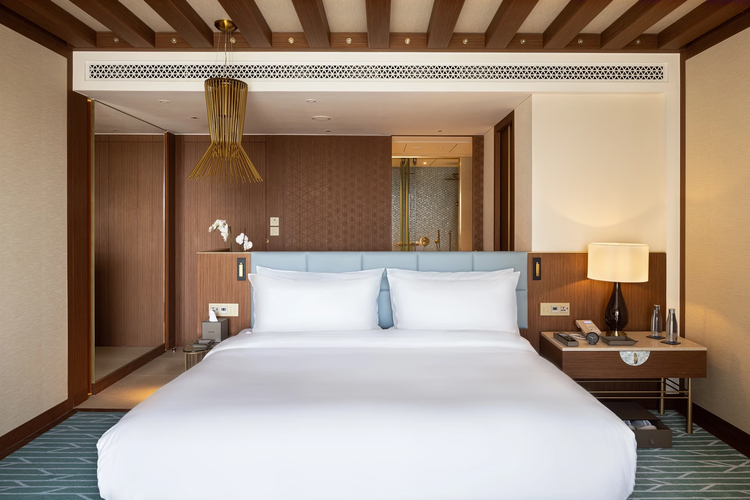
Hotel Bedding Package Guide: Mattresses, Pillows, Duvets & Bedding
A hotel bedding package should be planned as a coordinated sleep system rather than as a collection of independently purchased products. Mattress dimensions, pillow specifications, duvet sizes and bedding should correspond with the hotel’s room types, bed configurations, comfort standards and operational requirements.
For hotel groups, developers, FF&E procurement companies and project buyers, a structured bedding package simplifies specification, quotation, production and room allocation. The procurement process should define each product clearly, connect it to the correct room type and maintain consistency across the complete hotel project.

Build the Bedding Package from the Finished Bed
Start with the approved mattress width, length and finished height, then coordinate the sheet fit and duvet dimensions. The label “King” is not a complete purchasing specification. A bedding schedule should also distinguish a room allocation from operational spares, so quantities are not counted twice.
As an illustrative check, lay the proposed bedding on the approved mattress sample and review fit, overhang and handling with the project team. Record the actual item references used for that review. Washing and care expectations should be agreed from the selected textile specifications; a generic bedding description does not establish shrinkage or service-life performance.
1. Define the Complete Hotel Bedding Package
Start by defining exactly which products are included in the project.
A coordinated hotel bedding package includes:
| Hotel Mattresses | Pillows |
| Duvets | Bedding Packages |
Each category should then be divided into individual item codes, specifications and quantities.
2. Start with the Room Schedule
The room schedule determines how the bedding package should be configured.
Identify:
| Room Type | Number of Rooms |
| Bed Configuration | Mattress Size |
| Bedding Configuration | Required Quantity |
| Spare Quantity | Project Schedule |
This information becomes the basis for the bedding BOQ.
3. Separate Bedding Packages by Room Type
Different room types can require different sleep products.
Typical configurations include:
King Room → King Mattress + King Duvet + Approved Pillow Package + Bedding
Twin Room → Two Twin Mattresses + Two Twin Duvets + Approved Pillow Packages + Bedding
Suite → Approved Mattress Configuration + Suite Bedding Package
Each configuration should have a clear room-type reference.
4. Build a Room-Type Matrix
A room-type matrix makes the complete package easier to manage.
| Room Type | Mattress | Duvet | Pillows | Bedding |
|---|---|---|---|---|
| Deluxe King | MT-K01 | DV-K01 | PL-01 | BD-K01 |
| Deluxe Twin | MT-T01 × 2 | DV-T01 × 2 | PL-01 | BD-T01 |
| Executive King | MT-K02 | DV-K01 | PL-01 | BD-K02 |
| Suite | MT-S01 | DV-S01 | Approved Package | BD-S01 |
Actual products and quantities should follow the approved project room schedule.
5. Assign Unique Item Codes
Every product should have a unique project code.
For example:
| Product | Code Structure |
|---|---|
| Mattress | MT-XX |
| Pillow | PL-XX |
| Duvet | DV-XX |
| Bedding Package | BD-XX |
The same codes should be used throughout quotation, BOQ, production, quality control, packing and delivery.
6. Build the Bedding BOQ
The BOQ should connect product specifications with project quantities.
Include:
Item Code → Product → Room Type → Dimensions → Specification → Quantity → Spare Quantity
A structured BOQ reduces quantity errors when several room configurations are involved.

7. Specify Hotel Mattresses First
The mattress establishes the basic dimensions of the sleep system.
Define:
| Width | Length |
| Finished Height | Internal Construction |
| Comfort Requirement | Ticking |
| Quilting | Edge Construction |
Do not rely only on size names such as King, Queen or Twin.
8. Coordinate Mattress Size with the Bed
The mattress dimensions should correspond with the approved bed configuration.
Review:
Bed Base → Mattress Width & Length → Finished Mattress Height → Headboard → Bedside Furniture
This is especially important when the hotel guest-room furniture is customized.
9. Define Mattress Construction
The mattress specification should identify the complete construction.
A typical specification structure can follow:
Ticking → Quilting → Comfort Layers → Foam Layers → Support System → Edge Construction → Base Layers
The approved construction becomes the basis for sample development and production.
10. Define Mattress Comfort
Comfort descriptions such as soft, medium or firm should not be used as the only production standard.
A more reliable process is:
Target Comfort → Mattress Construction → Physical Sample → Review → Approved Sample
The approved sample then becomes the benchmark for production consistency.
11. Coordinate Finished Mattress Height
Finished mattress height influences the complete appearance and usability of the hotel bed.
It should be coordinated with:
| Bed Base Height | Headboard Position |
| Bedside Table Height | Bedding Appearance |
Changing mattress height after furniture dimensions are finalized can affect the proportions of the guest room.
12. Define Pillow Types
Pillows should be specified as individual products rather than simply listed as “hotel pillows.”
Each pillow type should have its own item code and specification.
Hotels can coordinate different pillow configurations according to the approved project requirements.
13. Specify Pillow Dimensions
Record the finished dimensions numerically.
For each pillow, define:
Width × Length
Do not rely only on general terms such as standard, queen or king where exact dimensions are required.
14. Specify Pillow Fill
The fill specification has a major influence on pillow feel and performance.
Record:
| Fill Type | Fill Weight |
| Fill Distribution | Finished Loft |
| Cover Material | Construction |
The approved sample should establish the final pillow standard.
15. Coordinate Pillow Comfort
A hotel can use more than one pillow specification within the same room.
For example, an approved package can combine different comfort profiles to provide guests with a choice.
Each pillow type should remain separately identified in the BOQ.
16. Define Pillow Quantity per Room
Do not calculate pillow quantities only from the number of hotel rooms.
Use:
Room Type × Number of Beds × Pillows per Bed
Then add separately approved spare quantities.
This provides a more accurate procurement total.

17. Define Duvet Sizes
Duvet dimensions should correspond with the approved mattress and bed configuration.
Specify:
Width × Length
Different room types can require different duvet sizes even within the same hotel.
18. Specify Duvet Fill
The duvet specification should identify the approved fill.
Record:
| Fill Type | Fill Weight |
| Distribution | Construction |
| Cover Material | Finished Size |
The specification should be detailed enough for accurate quotation and production.
19. Define Duvet Construction
Duvet construction influences how the fill remains distributed across the product.
The approved construction should identify the required stitching or compartment arrangement together with the cover and fill specification.
The physical sample can be used to review the final loft, weight and overall feel.
20. Coordinate Duvet Size with Mattress Size
The duvet should provide the intended visual coverage when placed on the approved mattress.
Review the relationship between:
Mattress Width → Mattress Height → Duvet Width → Side Drop → Finished Bed Appearance
This is particularly important for luxury hotel rooms where bed presentation is a major visual element.
21. Define the Bedding Package
Bedding should be specified according to the actual project scope and approved bed configuration.
The package should clearly identify each included product rather than using a general description such as “complete bedding.”
Every component should have its own dimensions, material specification, quantity and item code.
22. Coordinate Bedding Dimensions
Bedding dimensions should correspond with the mattress and duvet specifications.
The package should be checked against:
| Mattress Width | Mattress Length |
| Mattress Height | Duvet Size |
| Pillow Size | Bed Configuration |
This prevents mismatched products within the final room package.
23. Define Bedding Materials
The project specification should identify the approved bedding material requirements.
Record the relevant information for each product, including:
Material → Construction → Color → Finish → Dimensions → Approved Reference
Material requirements should remain consistent throughout the complete project quantity.
24. Define Bedding Appearance
Hotel bedding forms part of the overall guest-room presentation.
Review:
| Color | Surface Appearance |
| Stitching | Edge Details |
| Finished Dimensions | Overall Coordination |
The bedding package should support a consistent bed presentation across repeated guest rooms.
25. Coordinate the Complete Sleep System
The individual products should now be reviewed as one coordinated system.
The relationship is:
Bed Configuration → Mattress → Pillows → Duvet → Bedding Package
Dimensions, comfort, quantities and appearance should be coordinated before production.

26. Develop Product Samples
Customized hotel projects should establish physical product references before mass production.
Samples can be developed for:
| Mattress | Pillow |
| Duvet | Bedding |
The exact sample requirements depend on the project and approved procurement scope.
27. Approve the Mattress Sample
The mattress sample should be reviewed for:
Dimensions → Construction → Comfort → Finished Height → Edge Support → Quilting → Appearance
Required modifications should be completed before final approval.
28. Approve Pillow and Duvet Samples
Pillow and duvet samples should be checked against their specifications.
Review:
| Dimensions | Fill |
| Fill Weight | Cover |
| Construction | Stitching |
| Feel | Appearance |
Approved samples become references for production.
29. Approve Bedding References
Bedding should be reviewed for dimensions, materials, construction and appearance.
The final approved references should be recorded clearly so that production does not rely on outdated project information.
30. Establish an Approved Package Standard
Once all components are approved, establish the complete room package.
For example:
Room Type K01
Mattress MT-K01
Duvet DV-K01
Pillow PL-01
Bedding BD-K01
This package code can be connected directly with the room schedule.
31. Control Material Consistency
Large hospitality projects can require repeated production across hundreds of products.
Control the approved materials for:
| Mattress Ticking | Mattress Comfort Materials |
| Pillow Fill | Pillow Covers |
| Duvet Fill | Duvet Covers |
| Bedding Materials | Approved Finishes |
Any approved changes should be documented before production.
32. Control Production Consistency
Mass production should reproduce the approved product standards.
Quality control should cover:
Materials → Dimensions → Construction → Sewing → Fill → Appearance → Product Identification
The inspection requirements should correspond with the individual product specification.
33. Inspect Mattresses
Mattress QC should include:
| Width & Length | Finished Height |
| Construction | Quilting |
| Sewing | Edge Finish |
| Overall Shape | Cleanliness |
The finished mattress should correspond with the approved sample and specification.
34. Inspect Pillows and Duvets
Check:
Dimensions → Fill → Weight → Distribution → Stitching → Cover → Appearance
Repeated products should remain consistent across the complete project quantity.
35. Inspect Bedding
Bedding inspection should cover the approved dimensions, materials and visible workmanship.
Review:
| Dimensions | Sewing |
| Material | Color |
| Edge Details | Appearance |
| Item Code | Quantity |
Products should be clean and ready for project-based packing.

36. Calculate Quantities by Room Type
Final quantities should be calculated from the approved room matrix.
A simplified structure is:
Room Quantity × Product Quantity per Room = Operational Quantity
Then add:
Operational Quantity + Approved Spares = Procurement Quantity
This calculation should be completed separately for each item code.
37. Define Spare Quantities
Spare quantities should be agreed during procurement rather than added informally during production.
Separate them clearly in the BOQ.
This allows the project team to distinguish between room allocation and operational spare stock.
38. Plan Room-Type Packing
For larger hotel projects, packing can be organized according to the product and room allocation requirements.
The project should maintain clear identification between:
Product → Item Code → Room Type → Quantity → Package
This helps receiving teams distinguish different sizes and specifications.
39. Use Project-Based Labels
Package labels can contain:
| Project Name | Room Type |
| Item Code | Product |
| Size | Quantity |
| Package Number | Destination |
The label information should correspond with the packing list.
40. Prepare a Detailed Packing List
The final packing list should provide traceability between the BOQ and physical shipment.
Use:
Item Code → Product Description → Size → Quantity → Package Number
Different mattress, pillow, duvet and bedding specifications should remain separately identifiable.
41. Protect Products for International Shipping
Sleep system products should remain clean, dry and protected during storage, handling and transportation.
Packing should reflect the characteristics of each product.
Mattresses require appropriate surface and handling protection, while pillows, duvets and bedding require suitable packaging for textile products.
42. Coordinate Export Delivery
For international hospitality projects, the complete procurement process can follow:
Room Schedule → Bedding BOQ → Product Specifications → Sample Approval → Mass Production → Quality Control → Project-Based Packing → Export Delivery
Maintaining consistent item codes throughout this workflow improves project traceability.

43. Compare Suppliers on the Complete Package
When evaluating suppliers, compare more than the price of individual products.
Review:
| Mattress Manufacturing | Pillow & Duvet Capability |
| Bedding Package Capability | Material Specifications |
| Sample Development | Production Consistency |
| Quality Control | Project-Based Packing |
| Quantity Management | Export Delivery |
The supplier should be able to coordinate the products as one hospitality sleep system package.
44. Use a Final Procurement Checklist
Before releasing the package for mass production, confirm:
| Room Schedule Confirmed | BOQ Confirmed |
| Mattress Sizes Confirmed | Mattress Construction Approved |
| Pillow Specifications Approved | Duvet Specifications Approved |
| Bedding Specifications Approved | Samples Approved |
| Quantities Confirmed | Spare Quantities Confirmed |
| Packing Requirements Confirmed | Delivery Information Confirmed |
Production should proceed from the final approved project information.
Conclusion
A hotel bedding package should be developed around the complete guest-room sleep system rather than by purchasing mattresses, pillows, duvets and bedding independently.
The mattress establishes the main dimensions and comfort foundation. Pillows and duvets require their own dimensions, fill and construction specifications, while bedding must correspond with the approved mattress, duvet and pillow configurations. All products should then be connected through room types, item codes, quantities and approved samples.
A structured procurement workflow can follow:
Room Schedule → Sleep System BOQ → Mattress Specifications → Pillow & Duvet Specifications → Bedding Package → Sample Approval → Mass Production → Quality Control → Room-Type Packing → Export Delivery
This approach gives hotel groups, developers and FF&E procurement teams a clearer method for controlling specifications, quantities and consistency across the complete hospitality bedding package.
Sleep Systems Procurement & Production Questions
What is included in a hotel bedding package?
For Craftell Home hospitality projects, the coordinated sleep system includes hotel mattresses, pillows, duvets and bedding packages according to the approved project scope and room schedule.
Should hotel bedding packages be different for King and Twin rooms?
Yes. Different bed configurations normally require different mattress, duvet and bedding dimensions, and the required quantities should be calculated separately by room type.
How should hotel pillow quantities be calculated?
Calculate the number of beds for each room type, multiply by the approved number of pillows per bed, and then add any separately approved spare quantities.
Should pillows and duvets have individual specifications?
Yes. Each product should have its own item code, dimensions, fill specification, cover construction, quantity and approved reference.
How should mattress and duvet sizes be coordinated?
The duvet should be selected according to the approved mattress dimensions, mattress height and intended finished bed appearance.
Why use a room-type matrix for hotel bedding procurement?
It connects each room type with its correct mattress, pillow, duvet and bedding package, making quantities, production and project allocation easier to control.
Should bedding samples be approved before mass production?
For customized hotel projects, approved product samples or material references provide a clearer production benchmark for dimensions, materials, construction and appearance.
Can mattresses, pillows, duvets and bedding be procured as one coordinated package?
Yes. They can be coordinated as one hospitality sleep system package, with individual product specifications connected through the room schedule and BOQ.
Explore Sleep System Project Resources
Continue with our sleep system solutions and selected projects.